Annette Simmons

  • About
    • About Annette
    • Annette in Action
  • Books
    • Territorial Games
    • A Safe Place for Dangerous Truths
    • The Story Factor
    • Whoever Tells the Best Story Wins
  • Services
  • The Six Kinds of Stories
  • Storytelling 101
    • Blog
    • Q & A
    • Metaphor Maps
  • Clients
  • Contact

April 28, 2020 by Annette Simmons Leave a Comment

Storytelling Moral Survival System: Part eleven (templates)

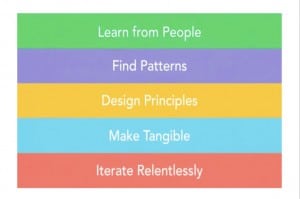
Design thinking is a form of story thinking.

Design thinking is a form of story thinking.


User Experience Stories: As <Persona> I want <What?> so that <Why?>

I remember teaching storytelling to Microsoft engineers in the early 2000s and explaining what I thought of as “story thinking” only to be told “no, that’s design thinking!” And it is, sort of. For me story thinking has always been agile enough to examine, test, and respond to intangible beliefs, values, emotions, as well as measurable feedback. Design thinking and Agile methods (project management processes that incorporate frequent reassessment and adaptation) simply formalize the sequence that best leads to functionally and perceptually rewarding goals. Developed to improve software design, User Experience (UX) templates and methods blend the work of a team of designers in ways that keep conclusions flexible and responsive as situations change. One way they keep things flexible is to pursue goals that feature users’ perceptual interpretations as “user stories.”

UX designers combine interviews (stories) and data to categorize consumers into personas, so they can fill in the blanks: “As <Persona> I want <What?> so that <Why?>” This template definitely keeps technology responsive to subjective human needs. The UX definition of a user story applies to the specific purpose of design, but the design-thinking process that goes with the idea of UX stories is exactly how I teach executives to find stories that connect and communicate a message. It introduces the discipline of testing whole stories in realistic circumstances rather than evaluating bits and pieces of a story against hypothetical scenarios. The Agile process encourages us to spend more upfront time in discovery (observing and listening to existing stories), and finding current patterns, before establishing guidelines (what is most important), so we can test and retest new stories until they click. The UX process puts first things first when it comes to storytelling.

The only danger with UX philosophy from my point of view, is the habit of characterizing all emotionally driven behaviors as “cognitive biases” (systematic errors). Putting all emotional reasoning into a basket labeled “systematic errors” makes it hard to reinforce moral biases that are only irrational in the short term but represent centuries of emotional reasoning for when, where, and how to override short term quid pro quo expectations in favor of long-term goals. Discrediting emotional reasoning creates emotion-less systems. To the overly rational, moral behaviors look like errors in judgment. We must be wary of people who suggest we “change the story,” when what they really mean is for us to change the morals that have put a dent in short term profits.

Emotion-based decision-making can be wrong, but that does not mean it is always wrong, or that emotions aren’t absolutely necessary for human decision – making. For instance, seeing a packed parking lot at a restaurant might make you decide to eat there, even though your emotions are biasing you to treat a correlation called social proof as if it were cause and effect. Packed parking lots do not cause good food. You were right for the wrong reasons. But jumping to the conclusion that cognitive biases like trusting social proof, basing choices on availability, or habits of loss avoidance are irrational and therefore wrong, ignores the fact that these habits have proven useful for centuries. When systems exploit rather than support cognitive biases, they potentially undermine critical reservoirs of social trust. For instance, social proof is a bias that encouraged cave men to drink water others had already tested. Categorizing “social proof” as a systematic error sidesteps moral concerns over manufacturing social proof by say, buying millions of Twitter followers. This betrayal undermines long-term trust in social proof to the point that collaboration becomes less and less likely.

Another bias called “loss avoidance” may also play a critical role to encourage “better safe than sorry” patterns that help us over-ride short term impulses in favor of living to fight another day. When storytellers exploit this bias by discouraging delayed gratification with threats of loss (“act now, offer ends soon!”) it erodes our emotional system for moderating unwise impulses. Stories that frame not voting as a way to avoid loss erode faith that voting—imperfect as it is—will allow us to avoid much bigger losses down the line.

Excerpt from Chapter 11, 3rd ed. of The Story Factor (2019)  AUDIBLE VERSION HERE

Filed Under: Uncategorized Tagged With: Annette Simmons, Big T Truth, business storytelling, Design thinking, narrative, storytelling, Storytelling Moral Survival System, The Story Factor, UX, Whoever Tells the Best Story Wins

April 21, 2017 by Annette Simmons 3 Comments

United Airlines: The Nurse Ratched Effect

Can safety becomesa pipeline to express resentment?

Can safety create a pipeline for resentment?


I stopped flying United Airlines a while back.  I remember the first time I felt harassed on a United flight. I asked for help lifting my backpack into the overhead. The flight attendant’s lip curled slightly as she said, “I am primarily here for your safety” with a tone that added the unspoken message, “so don’t treat me like a servant.” At the time, I assumed her anger was due to a snowballing series of unpleasant events and my assumptive request felt arrogant to her. It was not immaterial that she was black and I am white. I am active in racial reconciliation work in the Deep South so if race was part of it that makes sense to me.

But I see another pattern fueling tension between United employees and customers that recently led to man-handling a customer. And I’d be interested to hear your thoughts. Like all reality, there are predictable polarities in business – particularly service businesses. One big paradox is:

If the customer is always right… are employees still our most important asset?

I’m guessing United and other airlines adopted the “primarily here for your safety” perspective as a strategy to increase the dignity employees retain if/when customers are unkind. A guardian gets more dignity than a servant so this metaphor shifted the pendulum of empathetic perspective toward employees. And that’s wonderful. We should be taking better care of employees. This has been a long term strategy for United and it explains the CEOs initial solidarity with employees.

Yet the unintended consequence of increasing empathy for employees by characterizing them as guardians first, hosts second, simply shifts the burden to manage physical safety and psychological safety. Attempts to mechanize empathy seem to shift the burden by de-humanizing yet another context where personal attention matters. We are drowning beneath a tsunami of decisions chasing numbers at the expense of personal relationships and it is turning out exactly as you might imagine.

Systems designed to ensure physical safety frequently create a lack of psychological safety. Think Nurse Ratched. Or TSA (much better now). Systems and routines designed to minimize the situational nature of empathy only prevent the situational nature of empathy. Even hospitals enter a dangerous phase when numbers become more important that people. And it’s not restricted to a focus on safety. Last week, I felt harassed by endless phone calls from my car dealer strong arming me into completing a customer satisfaction survey. These poor people seem more incentivized to score satisfaction than deliver it. Competition for good numbers can turn good people into little nazis. We need two forms of measurement: numbers are great but qualitative measures matter too.

Numbers games teach winners to shift expenses and burdens onto losers – in United’s case – customers. Emphasizing physical safety  (measurable) over psychological safety (qualitative) builds autocratic systems that enforce preventative routines based on worst case scenario, root cause analysis, and the ethic of “better safe than sorry.” We can do better. The human need for empathy (and the consequences of empathy denied) will never be designed out of real life. So why not embrace the paradox, pursue safety and good numbers while remembering that the best way to get empathy is to give it.

P. S. Check out my updated audiobook version of The Story Factor on Audible!

Filed Under: Annette's Blog Tagged With: Annette Simmons, business storytelling, empathy, metaphor, paradox, patient experience, patient safety, polarity, safety, storytelling, United, United Airlines, User Experience, UX, Whoever Tells the Best Story Wins

Storytelling 101

I have a confession to make...

Storyteller’s Confession: My Secret Mission

October 5, 2021 8:59 am

I’ve been trying to infiltrate the halls of power for decades. My secret mission is to increase the diversity of thought by teaching those without a voice how to tell their stories and by teaching leaders how to find and retell stories that broaden everyone’s understanding. Read more →

Posted in: Uncategorized

Stories with a Moral Blueprint – part 8 of 8

May 14, 2020 8:43 am

  We need a Magic School for Storytellers Thirty years before J. K. Rowling created Harry Potter, Ursula Le Guin’s... Read more →

Posted in: Annette's Blog, Big T Truths

Stories with a Moral Blueprint – part 7 of 8

May 13, 2020 7:37 am

  Truth in Storytelling When I wrote the first edition of The Story Factor twenty years ago, I began with the... Read more →

Posted in: Uncategorized

Stories with a Moral Blueprint – part 6 of 8

May 12, 2020 6:48 am

The Moral Dilemmas of a Lion, a Scarecrow, and a Tin Man Frank Baum’s original introduction to The Wizard of... Read more →

Posted in: Annette's Blog, Big T Truths

Stories with a Moral Blueprint – part 5 of 8

May 11, 2020 8:38 am

  Blueprints for Building Trust Learning to drive was fun until I hit the mailbox. I burst into tears, blaming... Read more →

Posted in: Annette's Blog, Big T Truths

Subscribe to Annette's Blog via Email

Enter your email address to subscribe to this blog and receive notifications of new posts by email.

Like us on Facebook:

Like us on Facebook:

Contact Us

Group Process Consulting, LLC
phone: 318.861.9220
email: annette@annettesimmons.com
facebook: www.facebook.com/thestoryfactor

  • Storyteller’s Confession: My Secret Mission

    A Storyteller’s Confession I’ve been trying to infiltrate the halls of power for decades. My … Continue Reading…

    Storyteller’s Confession: My Secret Mission
  • Stories with a Moral Blueprint – part 8 of 8

      We need a Magic School for Storytellers Thirty years before J. K. Rowling created Harry … Continue Reading…

    Stories with a Moral Blueprint – part 8 of 8
  • Stories with a Moral Blueprint – part 7 of 8

      Truth in Storytelling When I wrote the first edition of The Story Factor twenty years … Continue Reading…

    Stories with a Moral Blueprint – part 7 of 8
© Copyright 2021, Group Process Consulting, All Rights Reserved.
Based on the ·Executive Pro Theme/Genesis Framework by StudioPress · Built using WordPress · Log in