Annette Simmons

  • About
    • About Annette
    • Annette in Action
  • Books
    • Territorial Games
    • A Safe Place for Dangerous Truths
    • The Story Factor
    • Whoever Tells the Best Story Wins
  • Services
  • The Six Kinds of Stories
  • Storytelling 101
    • Blog
    • Q & A
    • Metaphor Maps
  • Clients
  • Contact

May 12, 2020 by Annette Simmons Leave a Comment

Stories with a Moral Blueprint – part 6 of 8

oz

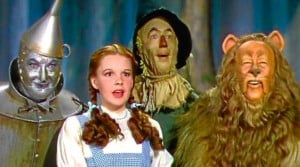
The Moral Dilemmas of a Lion, a Scarecrow, and a Tin Man

Frank Baum’s original introduction to The Wizard of Oz, written in 1900, made it clear that he felt children no longer needed the stereotypical “old-time fairy tale” that “may now be classed as ‘historical’ in the children’s library.” Baum claimed the time had come for “newer ‘wonder tales’ in which…the wonderment and joy are retained and the heartaches and nightmares are left out.” Still traumatized by watching the movie version as a child, I wanted to shout, “Flying monkeys!!”

In spite of Baum’s promise to throw out the bad and keep the good, he needed those scary flying monkeys and evil witches in order to deliver the promised wonderment and joy. The moral dilemmas in this story survived the transition into the movie version intact, even if Hollywood changed Dorothy’s silver slippers into ruby slippers and reinvented the good witch from a “face…covered with wrinkles, her hair…nearly white…[who]…walked rather stiffly” into glamorous Glinda, the Good Witch of the North.

Note that this hundred-year-old story has been farmed for leadership lessons for decades, including a self-published book on leadership lessons according to Toto, Dorothy’s dog. That’s because the The Wizard of Oz is a multi-moral story that illustrates paradoxical truths such as learning to appreciate home by leaving home, that what you seek externally is already inside, that courage doesn’t exist without fear, and risking self to save others can restore ones sense of self.

We seem equipped with emotions specifically designed to override extreme self-interest in favor of love and connections. If there is an evolutionary reason that humans living isolated lives suffer loneliness, then stories celebrate a wide range of feel-good solutions. Most offer blueprints that show how reaching out with love, making connections, and acts of generosity can be much more rewarding than winning as much as we can, as often as we can. The best stories teach us how to balance dueling desires for paradoxical goals like love and power rather than risk the danger of choosing only one over the other (a paradox that spreadsheets don’t reflect).

We learn how to determine whether it is time to connect or disconnect, to be firm or flexible, to tend relationships or go it alone, to use or set aside emotions, to reference past, present, or future, to exert control or invite participation. It takes the virtual reality of plots and characters to successfully toggle back and forth between technically contradictory yet complementary approaches. We find meaning not in choosing one over the other, but in embracing the paradox that we thrive by giving and receiving, by following and leading, by creating rules with exceptions that tend to relationships, and by both revealing and hiding our vulnerabilities.

Excerpt from Chapter 12, 3rd ed. of The Story Factor (2019)  AUDIBLE VERSION HERE

Filed Under: Annette's Blog, Big T Truths Tagged With: Annette Simmons, Big T Truth, business storytelling, communication, engagement, influence, inspiration, leadership, Moral Dilemmas, Stories with a Moral Blueprint, storytelling, Storytelling Moral Survival System, The Story Factor, Whoever Tells the Best Story Wins, Wizard of Oz

May 8, 2020 by Annette Simmons Leave a Comment

Stories with a Moral Blueprint – Part 4 of 8

"Believe in something, even if it means sacrificing everything."

“Believe in something, even if it means sacrificing everything.”


Brand Stories: Trust Based on Trustworthy Behaviors

Nike has employed corporate storytellers since the 1990s. Their decision to illustrate the “Just Do It” attitude with ads that support NFL star Colin Kaepernick’s decision to call attention to police brutality and racial injustice by kneeling during the National Anthem is an excellent example of supporting a moral story to correlate meaningful goals with commercial goals. While there was a temporary dip in Nike stock price, the stock price soared to new highs within a week. Sales showed an immediate increase in 2018 post Labor Day sales (31 percent) compared with the same time period in 2017 (17 percent). Those who might discredit Nike’s moral stories by pointing out that the company’s record is not pristine ignore the reality that no one, no institution, and no company is morally pristine.

We have to start where we are. That’s why we need stories that teach us how to face and forgive imperfections so second chances keep us moving toward virtues like justice. Gillette’s decision to call out toxic masculinity in a two-minute advertisement illustrating their tagline “The Best A Man Can Get” is yet another example of adding virtues to a product’s value proposition to increase trust and awareness. Public uproar not only increased awareness, it may have increased the trust that women who buy razors for men feel toward Gillette. Budweiser’s 2019 Super Bowl ad promoting wind energy just adds to the evidence that stories that illustrate moral backbone engage listeners.

Excerpt from Chapter 12, 3rd ed. of The Story Factor (2019)  AUDIBLE VERSION HERE
Filed Under: Annette's Blog, Big T Truths Tagged With: Annette Simmons, Big T Truth, business storytelling, Colin Kaepernick, communication, Gillette, Nike, Stories with a Moral Blueprint, storytelling, Storytelling Moral Survival System, The Story Factor, Whoever Tells the Best Story Wins

May 7, 2020 by Annette Simmons 2 Comments

Stories with a Moral Blueprint – part 3 of 8

Trust is the story of not doing what you could get away with, because you care about someone other than yourself.

Trust is the story of not doing what you could get away with, because you care about someone other than yourself.


Trustworthiness as Competitive Advantage

If morals need stories to thrive, it might also be true that stories need morals to thrive. Technically the stories you tell do not require moral intentions. Yet practical experience teaches us that few of the stories we cherish could possibly be classified as amoral. A story may not portray your preferred morals, but all stories, at least the interesting ones, embed moral lessons by correlating certain behaviors with consequences. It is hard to tell stories that reward faith in positive consequences like freedom, justice, and trust without exposing the truth that economic reasoning will never be equipped to achieve these kinds of subjective goals.

Few, if any, Hollywood blockbusters could demand our attention without portraying some kind of moral conflict between good and evil. Marvel’s 2018 movie Black Panther reinforces a similar moral lesson to the one Seuss teaches in The Cat in the Hat when the king decides to risk the danger of revealing his kingdom’s extravagant resources in order to clean up global messes. Disaster movies present one moral dilemma after another. Even the stories about characters who don’t know how to clean up their own messes (Thank you, Quentin Tarantino) deliver a moral lesson about the consequences of leaving messes for others.

Brian Boyd makes a strong case that storytelling is a survival mechanism in his book On the Origin of Stories, stating that humans have a “natural appetite” for information, “especially for pattern, and information that falls into meaningful arrays from which we can make rich inferences.” Stories pass along behavioral information that is just as important to our survival as the information passed along in our DNA.

Stories that stress mutual success might be more important now than they ever have been. The suicide rate for Americans is up 30 percent since 2000. Globally, suicide rates are up 60 percent over the past fifty years. According to the most recent Edelman Trust Barometer, the United States shows a “shattering loss of trust” that is the “steepest most dramatic decline in trust ever measured since the barometer began in 2000.” Over two thirds of the markets measured by Edelman Trust Barometer indicate trust levels below 50 percent.

There has to be a reason that “biology turns loneliness into a disease,” according to UCLA professor Steve Cole, who studies the effects of loneliness at the molecular level. The physical costs of isolation for adults is said to be a 25 percent increase in mortality that translates to AARP’s estimate of $6.7 billion annually in extra Medicare expenditures. “Me first” stories aren’t inherently bad, but a tsunami of “me first” stories leads to an erosion of trust when “me first” stories begin to replace “all for one, one for all” stories.

Social media systems designed to siphon off social trust to achieve short-term economic goals surely diminish the trust left over to achieve noneconomic goals, like sustaining faith in our fellow humans. The decision to trust corporate platforms with the care and maintenance of our social connections have revealed the dangers of this misplaced trust. We don’t trust friends who tell our secrets, and yet we temporarily trusted commercial interests that not only told but sold our secrets. Trust in Facebook dropped from 79 percent to 27 percent after customers learned the social platform ignored reports that Cambridge Analytica did not observe consent requirements before harvesting and exploiting the personal data of millions so they could pursue questionable political agendas using coercive stories.

It is hard for us to call out this kind of duplicity when we are overwhelmed with stories that drive us to seek speed rather than slow down long enough to reflect. When a corporation only rewards fast, measurable returns, it unintentionally marginalizes employees’ moral concerns and trains employees to “value growth above trust.” Like billionaire CEO Marc Benioff of Salesforce says, “A company like ours can’t be successful in an unsuccessful economy or in an unsuccessful environment or where the school system doesn’t work.” Benioff blends service work into the company culture so real-life experiences of showing and earning trust ensure employees are better equipped to identify the times when growth means losing trust. It’s a difficult choice to make, but almost always better in the long run to preserve trust by avoiding the option of exploiting “opportunities” that sacrifice trust you will need later on.


Excerpt from Chapter 12, 3rd ed. of The Story Factor (2019)  AUDIBLE VERSION HERE

Filed Under: Annette's Blog, Big T Truths Tagged With: Annette Simmons, Big T Truth, bio, business storytelling, communication, engagement, metaphor, narrative, Stories with a Moral Blueprint, storytelling, Storytelling Moral Survival System, The Story Factor, Whoever Tells the Best Story Wins

May 6, 2020 by Annette Simmons Leave a Comment

Stories with a Moral Blueprint – Part 2 of 8

towwn5

Meaning Makers

Any storyteller can train herself to ensure her stories support meaningful feelings. The first step is to acknowledge the numbers won’t always reflect the emotional payoffs of deferred self-interest. The second step is to decide to do it anyway. This kind of storyteller actively practices meaningful personal strategies that balance the needs of her circle of moral concern as well as her own needs. This is the sweet spot where we find meaning. Supporting others is an inside job that offers intangible rewards we collectively refer to as a meaningful life. This isn’t a new idea and it isn’t new to call ourselves out when we sense that meaninglessness might be reaching dangerous levels. Sixteenth-century poet John Donne started his famous poem with the phrase “no man is an island” and ended with the admonition “therefore never send to know for whom the bell tolls; it tolls for thee.”

It has always been the storyteller’s job to make the world feel more meaningful and help people feel more connected. Humans have intuitively understood the danger of isolation, and many cultural stories teach us specific ways to avoid being left alone. Most of these cultural lessons are variations on the theme: “Don’t be a jerk.” Maurice Sendak’s book Where the Wild Things Are uses only 338 words to illustrate the need to balance personal freedom with love of family. Nobody needs an evidence-based definition of a jerk supported by cost-benefit analyses. For a long time, the stories we shared ensured that most people knew a jerk when they saw one—particularly if he or she was staring back from the mirror. Now, not so much, which means more jerks, more loneliness, and more isolation.

Medical science proves our intuitive fear of isolation is well founded. Our bodies treat isolation like a mortal threat, fueling inflammation for autoimmune diseases just as our supercharged technology-mediated culture creates even higher levels of isolation. It is possible that placing all our faith in technical solutions temporarily stole our faith in social norms that have for centuries taught us—not all, but enough of us—to protect ourselves from isolation by practicing tolerance, forgiveness, and empathy. Well-intentioned efforts to evangelize the power of technical reasoning may have inadvertently starved our cultural faith that protecting family time and other rituals that preserve meaningful connections are more important that the profits we gain by forfeiting connections.

Faith in the inherent value of moral motivations is either sustained with personal experiences and stories that keep that faith alive, or it isn’t. There must be a good reason that we crave stories that show how suffering is meaningful. The cherished Charlotte’s Web is, after all, about a spider who places her friend Wilbur’s life above her own. Nietzsche’s observation that “he who has a why can endure any how” sustained Viktor Frankel as he recounted his suffering in concentration camps in his book Man’s Search for Meaning. Humans crave stories that show how love, trust, honesty, and justice prevail in spite of selfishness or greed. We crave these stories like we crave water—and they may be just as important for our survival. The stories we tell become the maps we use to chart our lives. If we perpetuate stories that unintentionally send the message that money can buy love, people act accordingly. Lucky for us, it doesn’t take long to realize substituting money for love is a pretty lonely story.

Excerpt from Chapter 12, 3rd ed. of The Story Factor (2019)  AUDIBLE VERSION HERE

Filed Under: Annette's Blog, Big T Truths Tagged With: Annette Simmons, business storytelling, leadership, Moral Blueprint, narrative, storytelling, Storytelling Moral Survival System, The Story Factor, Whoever Tells the Best Story Wins

April 29, 2020 by Annette Simmons 4 Comments

Storytelling Moral Survival System: part 12 (suggestions)

Make sure your stories always make your own heart sing.

Make sure your stories always make your own heart sing.

Art Your Heart into Storytelling

I worry that people who promise to science the shit out of storytelling haven’t been doing it long enough to understand how linear reasoning can ruin the flow of the creative process. Wise mystics used stories precisely to capture life’s mysteries intact, so anyone who promises to de-mystify storytelling needs to either explain how to re-mystify these paint-by-number stories or stop oversimplifying the process. If you agree, I believe the answer is to always put your heart into every story you find, develop, and tell. Not someone else’s hypothetical heart, but yours, the one that beats inside your chest when you feel inspired and suffers when you see others suffer. Now that storytelling ideas and advice are increasingly translated to suit the goals of technology and digital media, protecting a few primary concepts from being sliced and diced will help storytellers stay in touch with centuries of storytelling wisdom that is impossible to accommodate in linear binary formats. Novelist Haruki Murakami explains it this way: “In many cases, it’s because works that critics see as analytically excellent fail to win the natural empathy of readers.”

Excerpt from Chapter 11, 3rd ed. of The Story Factor (2019)  AUDIBLE VERSION HERE
Filed Under: Annette's Blog Tagged With: Annette Simmons, business storytelling, communication, influence, inspiration, narrative, storytelling, Storytelling Moral Survival System, The Story Factor, Whoever Tells the Best Story Wins

April 28, 2020 by Annette Simmons Leave a Comment

Storytelling Moral Survival System: Part eleven (templates)

Design thinking is a form of story thinking.

Design thinking is a form of story thinking.


User Experience Stories: As <Persona> I want <What?> so that <Why?>

I remember teaching storytelling to Microsoft engineers in the early 2000s and explaining what I thought of as “story thinking” only to be told “no, that’s design thinking!” And it is, sort of. For me story thinking has always been agile enough to examine, test, and respond to intangible beliefs, values, emotions, as well as measurable feedback. Design thinking and Agile methods (project management processes that incorporate frequent reassessment and adaptation) simply formalize the sequence that best leads to functionally and perceptually rewarding goals. Developed to improve software design, User Experience (UX) templates and methods blend the work of a team of designers in ways that keep conclusions flexible and responsive as situations change. One way they keep things flexible is to pursue goals that feature users’ perceptual interpretations as “user stories.”

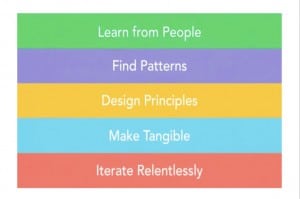
UX designers combine interviews (stories) and data to categorize consumers into personas, so they can fill in the blanks: “As <Persona> I want <What?> so that <Why?>” This template definitely keeps technology responsive to subjective human needs. The UX definition of a user story applies to the specific purpose of design, but the design-thinking process that goes with the idea of UX stories is exactly how I teach executives to find stories that connect and communicate a message. It introduces the discipline of testing whole stories in realistic circumstances rather than evaluating bits and pieces of a story against hypothetical scenarios. The Agile process encourages us to spend more upfront time in discovery (observing and listening to existing stories), and finding current patterns, before establishing guidelines (what is most important), so we can test and retest new stories until they click. The UX process puts first things first when it comes to storytelling.

The only danger with UX philosophy from my point of view, is the habit of characterizing all emotionally driven behaviors as “cognitive biases” (systematic errors). Putting all emotional reasoning into a basket labeled “systematic errors” makes it hard to reinforce moral biases that are only irrational in the short term but represent centuries of emotional reasoning for when, where, and how to override short term quid pro quo expectations in favor of long-term goals. Discrediting emotional reasoning creates emotion-less systems. To the overly rational, moral behaviors look like errors in judgment. We must be wary of people who suggest we “change the story,” when what they really mean is for us to change the morals that have put a dent in short term profits.

Emotion-based decision-making can be wrong, but that does not mean it is always wrong, or that emotions aren’t absolutely necessary for human decision – making. For instance, seeing a packed parking lot at a restaurant might make you decide to eat there, even though your emotions are biasing you to treat a correlation called social proof as if it were cause and effect. Packed parking lots do not cause good food. You were right for the wrong reasons. But jumping to the conclusion that cognitive biases like trusting social proof, basing choices on availability, or habits of loss avoidance are irrational and therefore wrong, ignores the fact that these habits have proven useful for centuries. When systems exploit rather than support cognitive biases, they potentially undermine critical reservoirs of social trust. For instance, social proof is a bias that encouraged cave men to drink water others had already tested. Categorizing “social proof” as a systematic error sidesteps moral concerns over manufacturing social proof by say, buying millions of Twitter followers. This betrayal undermines long-term trust in social proof to the point that collaboration becomes less and less likely.

Another bias called “loss avoidance” may also play a critical role to encourage “better safe than sorry” patterns that help us over-ride short term impulses in favor of living to fight another day. When storytellers exploit this bias by discouraging delayed gratification with threats of loss (“act now, offer ends soon!”) it erodes our emotional system for moderating unwise impulses. Stories that frame not voting as a way to avoid loss erode faith that voting—imperfect as it is—will allow us to avoid much bigger losses down the line.

Excerpt from Chapter 11, 3rd ed. of The Story Factor (2019)  AUDIBLE VERSION HERE

Filed Under: Uncategorized Tagged With: Annette Simmons, Big T Truth, business storytelling, Design thinking, narrative, storytelling, Storytelling Moral Survival System, The Story Factor, UX, Whoever Tells the Best Story Wins

  • 1
  • 2
  • 3
  • Next Page »

Storytelling 101

I have a confession to make...

Storyteller’s Confession: My Secret Mission

October 5, 2021 8:59 am

I’ve been trying to infiltrate the halls of power for decades. My secret mission is to increase the diversity of thought by teaching those without a voice how to tell their stories and by teaching leaders how to find and retell stories that broaden everyone’s understanding. Read more →

Posted in: Uncategorized

Stories with a Moral Blueprint – part 8 of 8

May 14, 2020 8:43 am

  We need a Magic School for Storytellers Thirty years before J. K. Rowling created Harry Potter, Ursula Le Guin’s... Read more →

Posted in: Annette's Blog, Big T Truths

Stories with a Moral Blueprint – part 7 of 8

May 13, 2020 7:37 am

  Truth in Storytelling When I wrote the first edition of The Story Factor twenty years ago, I began with the... Read more →

Posted in: Uncategorized

Stories with a Moral Blueprint – part 6 of 8

May 12, 2020 6:48 am

The Moral Dilemmas of a Lion, a Scarecrow, and a Tin Man Frank Baum’s original introduction to The Wizard of... Read more →

Posted in: Annette's Blog, Big T Truths

Stories with a Moral Blueprint – part 5 of 8

May 11, 2020 8:38 am

  Blueprints for Building Trust Learning to drive was fun until I hit the mailbox. I burst into tears, blaming... Read more →

Posted in: Annette's Blog, Big T Truths

Subscribe to Annette's Blog via Email

Enter your email address to subscribe to this blog and receive notifications of new posts by email.

Like us on Facebook:

Like us on Facebook:

Contact Us

Group Process Consulting, LLC
phone: 318.861.9220
email: annette@annettesimmons.com
facebook: www.facebook.com/thestoryfactor

  • Storyteller’s Confession: My Secret Mission

    A Storyteller’s Confession I’ve been trying to infiltrate the halls of power for decades. My … Continue Reading…

    Storyteller’s Confession: My Secret Mission
  • Stories with a Moral Blueprint – part 8 of 8

      We need a Magic School for Storytellers Thirty years before J. K. Rowling created Harry … Continue Reading…

    Stories with a Moral Blueprint – part 8 of 8
  • Stories with a Moral Blueprint – part 7 of 8

      Truth in Storytelling When I wrote the first edition of The Story Factor twenty years … Continue Reading…

    Stories with a Moral Blueprint – part 7 of 8
© Copyright 2021, Group Process Consulting, All Rights Reserved.
Based on the ·Executive Pro Theme/Genesis Framework by StudioPress · Built using WordPress · Log in