Annette Simmons

  • About
    • About Annette
    • Annette in Action
  • Books
    • Territorial Games
    • A Safe Place for Dangerous Truths
    • The Story Factor
    • Whoever Tells the Best Story Wins
  • Services
  • The Six Kinds of Stories
  • Storytelling 101
    • Blog
    • Q & A
    • Metaphor Maps
  • Clients
  • Contact

December 12, 2019 by Annette Simmons 5 Comments

The Spirituality of Storytelling…with animals!

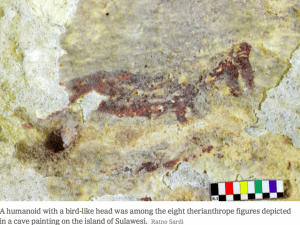
therianthrope

Do your stories have a spiritual message?

Or…perhaps we should ask ourselves what spiritual message do our stories tell?  Because all storytelling delivers a spiritual message.  The message may be spiritually rich or poor but it is there.  And it seems like spirituality has been at the core of storytelling from the beginning.  A recent article about newly discovered cave paintings in central Indonesia illustrates what is still a common trope – interpreting humanity through the lens of animal characteristics – from Aesop’s stories about the lion and the mouse to the three little pigs, animals have been recruited represent our values. Stories with animals tend to explore spiritual themes (compassion, courage, conservation) that illustrate the way we struggle to balance our lower and higher natures. Here is a quote from a Dec. 11, 2019 article:

Despite these unresolved mysteries, it is now abundantly clear that these humans were storytellers whose abstract paintings shed light into the origins of human cognition and spirituality.

Over forty thousand years ago the urge to tell a story represented far more than a desire for individual gain.  Newly discovered images of the earliest example of storytelling featured “therianthropes” – characters that embody a mix of human and animal characteristics. Our storytelling instincts were far less about individual profit and much more about collective wellbeing.  We risk a failure of the spirit when we forget this. (as well as a failure to address climate change and other global problems)

I first encountered ancient therianthropes in Museo del Oro in Bogata where solid gold characters blended the characteristics of humans and animal spirits. And more recently, when a friend who has a bad habit of suppressing his creative spirit to please others showed me a small brass tiger he carried in his pocket to remind him to act with courage. What animal spirit would improve the spiritual message in your storytelling?

Filed Under: Uncategorized Tagged With: Aesop's Fables, Annette Simmons, business storytelling, leadership, narrative, spirituality of storytelling, story, storyteller, Sulawesi, The Story Factor, therianthrope

October 30, 2018 by Annette Simmons 8 Comments

Ten Games People Play to Control Truth (2)

The Intimidation Game (2nd of ten):

Back off or you will be sorry.

Back off or you will be sorry.

The transcribed stories from the original research still describe how intimidation games scare people away from a game player’s protected “territory:”

All of a sudden he flared into a defensive kind of maneuver. He lapsed into another language…It was uncharacteristic of this guy. He turned crimson.  He was saying, ‘I made the decision. It was my judgment to make.’ Underneath all that, I was hearing, ‘Look, back off. Say out of my turf regardless of the data”

“He was angry. His face got red. Then he became accusatory and belligerent. He said the people who had done the study didn’t know what they were doing. The outcome in my opinion was that the subordinates of the manager said, “well, it looks like we don’t go out and ask anybody questions any more.”

Learning to not ask questions may be the worst outcome of the intimidation game.  Particularly now when asking questions is so dangerous it might cause someone to send you a pipe bomb – a radical acceleration of the intimidation game.

Used to be… when someone tried to control your ability to ask about or speak truth using intimidation – i.e. social, sexual, verbal, emotional attack or humiliation designed to embarrass you, frighten you, shut you down, shut you up or back you off – the most elegant solution was to calmly stand your ground and let the game player learn that intimidation doesn’t work on you or just let them escalate until they look like the crazy one as you sit there being your best “Ghandi self.” One of the black women I interviewed projected this idea from the hypothetical into the realm of possibilities when she told me her story: She felt intimidated into leaving a meeting when a terse white male boss whispered, “you don’t actually need to stay.” She flushed with embarrassment, left the room, and when walking down the hall came to herself – decided she had every right to sit in on that meeting – and walked back in, calmly taking her seat with every ounce of dignity intact and zero visible resentment. Staying sane while standing your ground does work.  Another favorite story was when a 2 star General screamed at a female Lt. Col. “WHY DON’T YOU JUST GROW UP!?!!” only to have her lean calmly back and ask, “Okay, but could you be more specific?” So for sure, in many cases, the intimidation game can’t work if you don’t participate.

On the other hand I admit as a woman it is still very difficult for me to stay sane when a man escalates the intimidation game – particularly when using sexual harassment triggers.  Old PTSD kicks in my “freeze” mode or hyper-activates my fight/flight responses and I “lose it.” For me, the #metoo movement is like a support group for women who have decided we will no longer be intimidated by territorial games.  I genuiely believe that women have to work together to fight this sexualized form of the intimidation game.  But I digress. Yes, the intimidation game can be gender specific – but it is also universally human for multi-gendered tribes who CONTROL information, status, and relationships to use intimidation games to silence true stories about any injustice, inequity, or dehumanization embedded in their preferred solutions.

Facing an intimidation game with non-violent noncompliance still works as long as the intimidation is a bluff.  Those of us who have previously been intimidated from truth telling need good strategies when power brokers use the intimidation game to silence or force our collusion. We have to train ourselves ahead of time to breathe deep when we hear an escalated voice, personal attack, or other threat.

“I’ve observed in meetings that key managers or top managers in an organization – particularly when they’ve got subordinates in the room – can be very intimidating. If they don’t like what they are hearing, they will give either verbal or body language …[and] rather than pursue a particular point, the subordinate will shut down. Some signals are furrowed brows narrowed eyes, shaking the head back and forth or even shouting, “What in the hell are you talking about?” So they effectively shut down something …that feels threatened as a result of what they say.

And it’s not just in meetings now of course.  Online “dialogue” allow trolls to expand intimidation game to a depersonalized extreme now that technology sequesters them from experiencing negative consequences for speaking to others with inhumanity and disrespect. I have also experienced the intimidation game from certain clients whenever I try to talk about the ethics and morals of storytelling. It’s turned nasty at times. Nasty enough for me to walk away.  I feel a bit ashamed that I gave in – another reason to start writing out loud about it.

Also…you know what I find intimidating now? The amount of time I have to stay on the phone to ask a question about my health or my finances. It takes effort to stay obedient to the procedures required of me before I am allowed to ask a question or cancel a service.  In some cases it means sitting on hold, waiting for instructions to press the right numbers while trying to tune out force fed marketing messages, in other cases it means signing in to an online system designed to keep me in line, keeping track of intentionally meaningless passwords that change every month, forfeiting privacy and agreeing to god knows what terms and conditions, until I give up on justice or healthcare completely.  Which lately, I must confess has caused me to back off, give up, hibernate, avoid, and hunker down. I’m just hoping writing this journal will help reverse my backward motion.

I’m not saying I have answers. I’m simply writing about these ten games to re-examine what’s going on at a granular level so we can maybe get a more accurate perspective of how these formerly “in-person” games have translated to technological dogma and algorithms.

Filed Under: Annette's Blog, Big T Truths Tagged With: Annette Simmons, business storytelling, influence, integrity, narrative, Territorial Games, The Story Factor, true stories, Whoever Tells the Best Story Wins

July 3, 2017 by Annette Simmons 3 Comments

Budweiser Storytelling Genius Used for Good

I just watched the new Budweiser commercial for July 4 this year and I think it is genius.  They used story to do good as well as make money. Lately I’ve been disturbed by mechanistic applications of story, but this? This is big picture, risky, embedded with big T Truth and I hope it does what it seems to have been designed to do.

Budweiser invites liberals and conservatives to remember who they are and why they are here, and to have a damn beer fer crissakes. The common good intentions of left and right are symbolized by the conservative cues framing the family of the veteran and his daughter as obviously conservative they add an even heavier handed cues about liberal Hollywood to characterize Adam Driver.  Then they dissolve their different POVs with the shared tragedy of both men being wounded before deployment and dealing with pain and survivors guilt.

I try to imagine… what was the dialogue in the conference room when they made the decision

“Should we do it?”

“It’s risky.”

“You are f—ing idealists.”

“It tested well.”

“Screw it, we’re going to do it.”

Of course they tested this ad. I admit preliminary the comments I’ve read are accusatorial jabs from die hard haters from both sides. But I hope that over time, the idea of just sitting down and having a beer comparing what we care about most…will bring some sanity to the current political arena.

If not, I’ll just drink a Bud and try not to worry about it.

Filed Under: Uncategorized Tagged With: Annette Simmons, BUDWEISER, business storytelling, communication, engagement, JULY 4, narrative, story, The Story Factor, Whoever Tells the Best Story Wins

January 3, 2017 by Annette Simmons Leave a Comment

Storytelling and UX: Separated at Birth

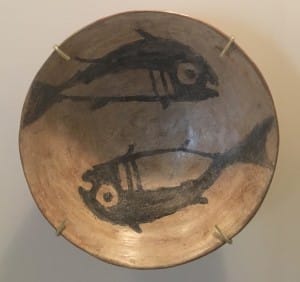
Plate Design pre-800 A.D. Nazca tribe, Cusco Peru

Plate designed 0-800 A.D. by Nazca tribe, Peru

In 2004 I introduced my ideas about story-thinking to a bunch of design engineers who responded  “no, no, that’s design-thinking.” So I fell in love with design thinking…genuises like Dan Lockton (101 patterns for behavior change), Jan Jursa and UX Storytellers (free ebook with personal UX stories) create designs that are stories. Perhaps story thinking and design thinking are not an exact match but the steps of find/share/refine from UX, Agile,  and Scrum sources are delightfully nonlinear (story) compared to the decision routines I learned from management by objective techniques (i.e. SMART goals) and I like the conversations of UX people.   They ignite the imagination to pursue goals we can’t yet see.

I have an issue with the UX term “cognitive bias” because EMOTION should be in there somewhere and “bias” makes humans sound like stupid cows who might follow a cattle chute wherever it goes. Even cow chutes can fail until a designer understands the stories cows tell themselves (see Temple Grandin). Human patterns of interpretation can utilize rational tools but our patterns irrevocably reflect the DNA of physical experience and emotional reasoning. Every “cognitive bias” makes as much sense as any stereotype makes sense. It shouldn’t be universally applied, but it comes from an organic place.  I’m happy to know that Dan Ariely says his term “predictably irrational” refers to the idea that it is irrational to think you can predict your own behavior. It is not a blanket disdain for these patterns of behavior. Emotional reasoning is and forever will be more powerful than rational decision making and I see that as a good thing because our future will be much better when we learn to blend emotions like empathy, compassion and love into our ratios.

Before demand for content reduced storytelling to a sequence of linear explanations and numbered bullets, it was mostly taught in person.

Learning storytelling in a group from an experienced storyteller provides an experiential sense of story that can’t be captured with a set of procedural instructions.  There are great courses out there.  We can learn a lot online…but if we want to understand something as deeply human as storytelling its ideal for humans to interact with other humans.

Here’s why: A story blends emotional, visual, kinesthetic and rational reasoning routines without separating them.  Personal stories illuminate insights that are specific to a situation’s people, complexity, texture and relationships. A vibrant true story delivers a hologram of culture, nature, nurture, space and time from an embodied human point of view: WAY more information than a story formated via a hunt and peck search for hero, quest, obstacle, helper and journey.

The job of a storyteller is two-fold. First, a storyteller notices the emotional, visual, and kinesthetic patterns that produce perceptions (i.e. what makes some facts feel more important than other facts) and interpret conclusions (I “know” him therefore he is more trustworthy).  Second, a storyteller must be able to re-create this perceptual/emotional point of view so others share the insights and the feelings as if they were physically there.

Yes, any story that provides your listeners with a vicarious experience of your facts in time and space makes your facts feel more “real” …with all the benefits of that, but to me, the real value of storytelling is the way it allows us to aggregate contexts and shift perspectives so we make better decisions.  When rational objective reasoning is allowed to over-rule subjective story reasoning we end up with projects that should’ve worked, but didn’t because emotions and perceptions rule human reality.

More than a set of tool to persuade, story-finding and storytelling skills increase the variety and quality of scenarios we can imagine to produce the results we seek – sometimes revealing even better goals in the process. Any story that narrates a relevant “Significant Emotional Event” (without some imposed structure) helps us S.E.E. important patterns, better test prototypes, and understand user experiences.

Designing cattle chute stories/interfaces that only lead to pre-determined conclusions is not engaging it is coercion. Narrating stories with the priority of understanding (not controlling) true human experiences releases listener conclusions to be creative and more meaningful to you both.  It means showing faith in your listeners (always appreciated) and sharing responsibility for mutually creative interpretations and actions. There is no “right story.” If you look for the perfect story you sacrifice the process of mindful attention to what is, in favor of what you want to see.  Both are valid…but I’m thinking we could all do a better job of understanding what is.

So to all my UX colleagues, please don’t let your understanding of storytelling get distorted with contrivances created to package and sell storytelling advice.  User experiences with emotion and unpredictability intact are too valuable to the process of innovation to be reduced to fit existing categroies. Be bold.

Filed Under: Annette's Blog Tagged With: Annette Simmons, business storytelling, interview techniques narrative, The Story Factor, Whoever Tells the Best Story Wins

September 16, 2016 by Annette Simmons 1 Comment

The Story Factor Audiobook: Connecting the Dots 2001-2016

The Story Factor is now updated and available on audible as an audiobook. Fifteen years of perspective and a genius editor (Stephen Brewer) helped me cut it from 13 hours to 5 hours flat. Producers Jay and Michelle from Beyond Measure Media took me into a real studio and monitored sound quality and my energy levels to meet their high standards. I hope you like it.

In the Steve Jobs tradition, I thought I’d “connect the dots” between the obsessive research (you have no idea), designed interventions, and no charge experiments I’d run on any group of volunteers that would let me and the journey that lead to the original  The Story Factor back in 2001.  I was still in grad school when I attended my first National Storytelling Festival in 1994, but it was a long time I realized how important storytelling is or learned enough to describe storytelling as a type of “intervention.”

In fact, The Story Factor was the third book in a series of three intense periods of research and experimentation, design and testing that began with my search to increase authentic collaboration.  In 1994 my mentor Dr. Jim Farr (founding contributor to Center for Creative Leadership) taught me how to deliver learning experiences using transformational self awareness techniques that improved leadership skills by blending soul-deep examination of intent and beliefs in a way that clarified their definition of success and for some, redirected the traectory of their life.  So… the “team building” tools at that time just seemed terribly superficial in comparison to my experiences running these workshops. I was certain I could find a leverage point for self-awareness that would shift the negative emotions wasting time and resources with phrases like “not my job,” or avoided questions with “who wants to know?” I set out to identify what patterns work against team building:  “When, where, how do we reject collaboration and why?”

For instance, in meetings, subtle messages like a stiff tone of voice, raised eyebrows, or strategically insincere agreements erode trust and decrease our desire to collaborate, share information, support, or even to save the game player from drowning down the line.  So the first book, Territorial Games named ten micro-behaviors or repeated patterns from hundreds of executive’s true stories I had recorded and transcribed.  Most answered first with metaphors like turf war, back stabber, silo or the thank-god-its-a-metaphor “pissing contest.” I’d point out the metaphor was not literally true and then ask “so what actually happened?” These true stories revealed a subterranean language of inclusion and exclusion understood across all cultures. My theory was that evolution designed us with insincts a/k/a emotions  that compel us to acquire and protect territory: no longer hunting grounds and watering holes but the intangible territory that helps us survive and thrive: information, relationships, and status.  Therefore a rational, cognitive desire to collaborate was insufficient without vital emotions like trust and faith.

So AMACOM published Territorial Games and give it away as the 1998 membership gift for joining American Management Association. Clients hired me to help plan mergers, de-escalate infighting, and unlock impasse.  The games worked best with funny stories that neutralized defensiveness and increased self awareness. I provided an alternative story for the “who started it?” question to decrease assumptions of malicious or negligence, which is that these emotional behaviors are hardwired by evolution for survival. “If you play these games, it’s okay, its not your fault…but guess what…those people who you think deserve payback?  It’s not their fault either.” This new story increased self-compassion and a reason to monitor behaviors that sent unconscious signals to back off.  For those who are doing it on purpose – the list of games denied them plausible excuses.

Still, there were long term turf wars that would never go away until all the old stories were exposed to each other in a way that created a bigger story than the us/them causing problems.  Back in grad school (1994) I had written my masters thesis on “dialogue,” drawing from organizational learning, systems theory, social psychology, In 1996 I got ahold of David Bohm’s “On Dialogue” and continued my enduring study of anything from Ed Schein on group process. Armed with this understanding, and the crafty little tricks I learned from my mentor, I wrote A Safe Place for Dangerous Truths: Using Dialogue to Overcome Fear and Distrust.  It was an ambitious design for training a group (60 max, although it worked for 90 at least once) to a.) self-regulate by generating personal and group strategies for pre-empting what I’ve come to call “going to the bad place” and b.) shifting expectations to accomodate the feelings of uncertainty and sheer frustration of stretching your brain wide enough to see that everyone has a piece of the same elephant.  In that book is a shapter on Storytelling as one of the “seven basic facilitator skills.” This is the first time I used simple drawings for common group patterns instead of words.  It was a very successful form of visual storytelling even if I was not yet aware of it.

Everytime I facilitated dialogue I took notes to capture as close to a verbatim transcript as I could.  It turned out the “faulty assumptions” groups decided to abandon were basically stories. And every insight a group dsicovered by examining their bigger story required could not spread from that group to the organization without it’s own stories and metaphors. I realized l was an awkward fish swimming in an ocean of stories.  I wrote the The Story Factor to map the currents.

Fifteen years later, I took time to revisit, update and edit the maps in The Story Factor, producing this audiobook as a result. Let me know what you think!

Filed Under: Annette's Blog, Uncategorized Tagged With: Annette Simmons, business storytelling, group process, leadership, metaphor, narrative, storytelling, The Story Factor, Whoever Tells the Best Story Wins

February 24, 2015 by Annette Simmons 2 Comments

A “Good” Bad Girl – What Ameera is doing right!

Ameera Chowdhury tells a great story that reveals there is more to her than her good girl, unassuming appearance might indicate.   [Read more…]

Filed Under: Finding Stories, The Moth - Storytelling HOW TO Tagged With: Ameera Chowdhury, Annette Simmons, business storytelling, engagement, narrative, self confidence, significant objects, six stories, Storytelling 101, The Moth, The Story Factor, told live, true stories

  • « Previous Page
  • 1
  • 2
  • 3

Storytelling 101

I have a confession to make...

Storyteller’s Confession: My Secret Mission

October 5, 2021 8:59 am

I’ve been trying to infiltrate the halls of power for decades. My secret mission is to increase the diversity of thought by teaching those without a voice how to tell their stories and by teaching leaders how to find and retell stories that broaden everyone’s understanding. Read more →

Posted in: Uncategorized

Stories with a Moral Blueprint – part 8 of 8

May 14, 2020 8:43 am

  We need a Magic School for Storytellers Thirty years before J. K. Rowling created Harry Potter, Ursula Le Guin’s... Read more →

Posted in: Annette's Blog, Big T Truths

Stories with a Moral Blueprint – part 7 of 8

May 13, 2020 7:37 am

  Truth in Storytelling When I wrote the first edition of The Story Factor twenty years ago, I began with the... Read more →

Posted in: Uncategorized

Stories with a Moral Blueprint – part 6 of 8

May 12, 2020 6:48 am

The Moral Dilemmas of a Lion, a Scarecrow, and a Tin Man Frank Baum’s original introduction to The Wizard of... Read more →

Posted in: Annette's Blog, Big T Truths

Stories with a Moral Blueprint – part 5 of 8

May 11, 2020 8:38 am

  Blueprints for Building Trust Learning to drive was fun until I hit the mailbox. I burst into tears, blaming... Read more →

Posted in: Annette's Blog, Big T Truths

Subscribe to Annette's Blog via Email

Enter your email address to subscribe to this blog and receive notifications of new posts by email.

Like us on Facebook:

Like us on Facebook:

Contact Us

Group Process Consulting, LLC
phone: 318.861.9220
email: annette@annettesimmons.com
facebook: www.facebook.com/thestoryfactor

  • Storyteller’s Confession: My Secret Mission

    A Storyteller’s Confession I’ve been trying to infiltrate the halls of power for decades. My … Continue Reading…

    Storyteller’s Confession: My Secret Mission
  • Stories with a Moral Blueprint – part 8 of 8

      We need a Magic School for Storytellers Thirty years before J. K. Rowling created Harry … Continue Reading…

    Stories with a Moral Blueprint – part 8 of 8
  • Stories with a Moral Blueprint – part 7 of 8

      Truth in Storytelling When I wrote the first edition of The Story Factor twenty years … Continue Reading…

    Stories with a Moral Blueprint – part 7 of 8
© Copyright 2021, Group Process Consulting, All Rights Reserved.
Based on the ·Executive Pro Theme/Genesis Framework by StudioPress · Built using WordPress · Log in