Annette Simmons

  • About
    • About Annette
    • Annette in Action
  • Books
    • Territorial Games
    • A Safe Place for Dangerous Truths
    • The Story Factor
    • Whoever Tells the Best Story Wins
  • Services
  • The Six Kinds of Stories
  • Storytelling 101
    • Blog
    • Q & A
    • Metaphor Maps
  • Clients
  • Contact

November 3, 2018 by Annette Simmons 4 Comments

Ten Games People Play to Control Truth (3 of 10)

3. The Filibuster Game
Endless chatter that dominates the airwaves.

Endless chatter that dominates the airwaves.

“… we were just wasting our time. No one wanted to be the one to tell him he was full of crap so they just sat and listened to him ramble on. After all, no one could disagree with the fact that we needed to act more like a team.  But wasting all this time talking about our values and customer service didn’t solve the problem.  Everyone walked out of that meeting and went right back to the same old, same old.

I’ve been there. You’ve been there.  Now it’s happening on a national level and it’s no longer an irritation but a real threat. This quote above describes a meeting that happened over 20 years ago, but it’s happening again today, except game players now have “scaled” the filibuster game with technology that floods the airwaves with talking heads and images designed to activate clicks instead of collaboration.

The Filibuster Game has long been codified as a tactic in Congress: talk long enough and it prevents everyone else from telling his or her story.  Today technological variations of the filibuster game include apps that push notifications to the point we don’t have time to look for verification. Particularly if the “news” we get affirms our own goodness and blames those “idiots” for not understanding what’s real.

You aren’t going to like this but in experiments, peace makers sabotage their ability to confront the Filibuster game if they get stuck believing that a Filibuster game player knows exactly what he is doing and why.  Nope.  Most of the time, these game players genuinely think they are heroes protecting a value that the rest of us want to “destroy.” Calling a game player stupid (accurate or not) only doubles the energy he or she gives to the game.  Just to be clear, even those game players who are intentionally playing the filibuster game draw energy from your accusations.  The only way a game player stops playing games is if he/she can admit to him/herself in the privacy of his/her own mind: “I’ve been acting like an asshole. I think Im making things worse. I want to change for my own reasons” It’s not easy, not particuarly gratifying, but focusing on the games and not the people works faster – not 100% of the time because nothing works 100% of the time. But it works with small groups, so surely there is a larger scale approach.

IMO, I think we need to stop fighting each other and start fighting the games people play with the truth. We need checks and balances for airtime that is currently for sale to the highest bidder.

Most people who play the Filibuster Game don’t realize they are doing it. Fear and anxiety create a knee jerk physiological impulse they just can’t control.  All they know is that whatever you have to say distresses them, and they feel much better when they are talking instead of you. They will talk about anything except what you want to discuss. In corporate meetings the bluster mouth playing the filibuster game runs out the clock so other agenda items are never addressed. Filibuster is a fire hose of rhetoric that is not meant to communicate but to dominate.

This next quote was from a man describing a meeting, but you can imagine how this has translated to dominating media with loud engaging rhetoric that drowns out other stories.

In meetings when they get to the point where the gloves are off, it becomes very, very loud. The loudest and the most eloquent … He could make you listen, even though he was on the other side. He could compel you to listen by his rhetoric…You knew he was a snake. You knew full well…that what you were hearing was but a tip of his intent, what he was saying was only a portion of what he wanted you to hear. You know that what came before you on the table did not represent all that there was.

The filibuster game controls what we see as “True” by blocking out the stories deemed dangerous to a game player’s “preferred narrative.”  Some even label these other people’s stories as “anti-stories” and intentionally distract, block, nullify, or sideline those who are willing to risk telling the emperor he has no clothes.

Since we have a finite time amount of time to attend to different points of view, any media that fills our attention to capacity with a single story steals time from tough issues that arise when we admit there are at least 4 or 5 points of view, that may piss us off, but still need to be addressed.  When the flood of “something else, anything else” swirls within a media outlet it creates echo chambers (filibuster bubbles) designed to protect listeners from self-examination.

“People want to hang on to what they’ve got…so they generate so much data that it’s impossible to counteract.”

A flood of data makes it seem as if the problem we need to solve is to find a faster way to understand the data when solutions are much more likely to be found by sharing stories from all points of view, finding a way to walk a mile in the shoes of someone who knows what you don’t know, listening with empathy, generating mutual curiosity, or dialoging about Big T Truths.  This doesn’t happen unless game players somehow experience an emotional state that makes being vulnerable seem wise.  Attacking game players is satisfying but counterproductive. The trick is to get them to tell themselves the truth.

In my own experiements this rarely happens in isolation, but can be achieved in face-to-face group dialogue.


*******************************

BTW, my definition of Big T truths: human paradoxes than sound like opposites but are actually two poles that must be balanced in the middle. We balance helping individuals AND the collective, depending on rules AND relationships, and investing in safety AND freedom. For instance, the golden rule “treat others as you wish to be treated,” plots a middle way between my wants and your wants.




Filed Under: Big T Truths, Territorial Games, Truth Tagged With: Annette Simmons, business storytelling, influence, interview techniques narrative, Territorial Games, true stories, Whoever Tells the Best Story Wins

October 30, 2018 by Annette Simmons 8 Comments

Ten Games People Play to Control Truth (2)

The Intimidation Game (2nd of ten):

Back off or you will be sorry.

Back off or you will be sorry.

The transcribed stories from the original research still describe how intimidation games scare people away from a game player’s protected “territory:”

All of a sudden he flared into a defensive kind of maneuver. He lapsed into another language…It was uncharacteristic of this guy. He turned crimson.  He was saying, ‘I made the decision. It was my judgment to make.’ Underneath all that, I was hearing, ‘Look, back off. Say out of my turf regardless of the data”

“He was angry. His face got red. Then he became accusatory and belligerent. He said the people who had done the study didn’t know what they were doing. The outcome in my opinion was that the subordinates of the manager said, “well, it looks like we don’t go out and ask anybody questions any more.”

Learning to not ask questions may be the worst outcome of the intimidation game.  Particularly now when asking questions is so dangerous it might cause someone to send you a pipe bomb – a radical acceleration of the intimidation game.

Used to be… when someone tried to control your ability to ask about or speak truth using intimidation – i.e. social, sexual, verbal, emotional attack or humiliation designed to embarrass you, frighten you, shut you down, shut you up or back you off – the most elegant solution was to calmly stand your ground and let the game player learn that intimidation doesn’t work on you or just let them escalate until they look like the crazy one as you sit there being your best “Ghandi self.” One of the black women I interviewed projected this idea from the hypothetical into the realm of possibilities when she told me her story: She felt intimidated into leaving a meeting when a terse white male boss whispered, “you don’t actually need to stay.” She flushed with embarrassment, left the room, and when walking down the hall came to herself – decided she had every right to sit in on that meeting – and walked back in, calmly taking her seat with every ounce of dignity intact and zero visible resentment. Staying sane while standing your ground does work.  Another favorite story was when a 2 star General screamed at a female Lt. Col. “WHY DON’T YOU JUST GROW UP!?!!” only to have her lean calmly back and ask, “Okay, but could you be more specific?” So for sure, in many cases, the intimidation game can’t work if you don’t participate.

On the other hand I admit as a woman it is still very difficult for me to stay sane when a man escalates the intimidation game – particularly when using sexual harassment triggers.  Old PTSD kicks in my “freeze” mode or hyper-activates my fight/flight responses and I “lose it.” For me, the #metoo movement is like a support group for women who have decided we will no longer be intimidated by territorial games.  I genuiely believe that women have to work together to fight this sexualized form of the intimidation game.  But I digress. Yes, the intimidation game can be gender specific – but it is also universally human for multi-gendered tribes who CONTROL information, status, and relationships to use intimidation games to silence true stories about any injustice, inequity, or dehumanization embedded in their preferred solutions.

Facing an intimidation game with non-violent noncompliance still works as long as the intimidation is a bluff.  Those of us who have previously been intimidated from truth telling need good strategies when power brokers use the intimidation game to silence or force our collusion. We have to train ourselves ahead of time to breathe deep when we hear an escalated voice, personal attack, or other threat.

“I’ve observed in meetings that key managers or top managers in an organization – particularly when they’ve got subordinates in the room – can be very intimidating. If they don’t like what they are hearing, they will give either verbal or body language …[and] rather than pursue a particular point, the subordinate will shut down. Some signals are furrowed brows narrowed eyes, shaking the head back and forth or even shouting, “What in the hell are you talking about?” So they effectively shut down something …that feels threatened as a result of what they say.

And it’s not just in meetings now of course.  Online “dialogue” allow trolls to expand intimidation game to a depersonalized extreme now that technology sequesters them from experiencing negative consequences for speaking to others with inhumanity and disrespect. I have also experienced the intimidation game from certain clients whenever I try to talk about the ethics and morals of storytelling. It’s turned nasty at times. Nasty enough for me to walk away.  I feel a bit ashamed that I gave in – another reason to start writing out loud about it.

Also…you know what I find intimidating now? The amount of time I have to stay on the phone to ask a question about my health or my finances. It takes effort to stay obedient to the procedures required of me before I am allowed to ask a question or cancel a service.  In some cases it means sitting on hold, waiting for instructions to press the right numbers while trying to tune out force fed marketing messages, in other cases it means signing in to an online system designed to keep me in line, keeping track of intentionally meaningless passwords that change every month, forfeiting privacy and agreeing to god knows what terms and conditions, until I give up on justice or healthcare completely.  Which lately, I must confess has caused me to back off, give up, hibernate, avoid, and hunker down. I’m just hoping writing this journal will help reverse my backward motion.

I’m not saying I have answers. I’m simply writing about these ten games to re-examine what’s going on at a granular level so we can maybe get a more accurate perspective of how these formerly “in-person” games have translated to technological dogma and algorithms.

Filed Under: Annette's Blog, Big T Truths Tagged With: Annette Simmons, business storytelling, influence, integrity, narrative, Territorial Games, The Story Factor, true stories, Whoever Tells the Best Story Wins

October 23, 2018 by Annette Simmons 9 Comments

Ten Games People Play to Control Truth (1)

People seem to be applying the same ten games from Territorial Games (1997) to control narratives and thus control our perceptions of what is/isn’t true.  For the next ten weeks I’ll post about each of these ten games one at a time.

But first let me give a bit of background on the research. It all started with the metaphor, “turf war.” Everyone knew what “turf war” meant, but when I asked for stories every description just contained more metaphors (back stabber, empire builder, brown noser, etc). I wanted to know what actually happened, the behaviors, and the impact at a granular level.  SO, I asked people to tell me stories about “a time when I witnessed a turf war.” The metaphors started to translate to specific situations that eventually fell into ten buckets of behaviors.

Marking territory is quite common.

Marking territory is quite common.

What is a territorial game? What is territory?

In the late ‘90s we already had very few tangible kinds of territory to fight over except maybe office space (remember private office space?) The games were primarily used to control information, relationships, and status/popularity. Controlling these three intangible factors meant players could monopolize gateways to money, power, and more tangible goodies.  Today, it seems these ten territorial games have exponential potential to control global perceptions of truth.  Any storyteller determined to control “the” narrative has stopped seeking mutual truths in favor of a single story.

Today, these games are even less visible because technology hides games so they are much harder to name, resist or question. So many messages are shaped and promoted by entities seeking to game the truth, we are all either confused or escape into fundamentalism.  Personally I can’t even conceptualize solutions until I can examine which games perpetuate the biggest problems. Over the next few weeks I’ll do my best to translate old descriptions of each of the ten territorial games to current examples so we can decide if we think this is a useful way to describe the most common games people use to distort “dangerous” truths.

  1. Occupation Game:

The image that best evokes the idea of the occupation game is an dog marking his territory.  Just as often the Occupation Game is played like musical chairs. The game is all about getting there first, in as big a way as possible to occupy control of who/how/why people get information, access, or status. In musical chairs the player with the biggest butt who is most willing to knock someone else off a chair usually wins.  Sending an biting email with our version of the truth while copying far more recipients than necessary is a form of the occupation game. Occupation game players also withhold information (sit on it) if it they feel it might benefit their percieved “enemy” even in situations where sharing the information is the best way to achieve the organization’s mission.

Thank goodness I did this research when there were more tangible examples. Most of these behaviors are so far behind the scenes, written in code, and so complex we need metaphors to discuss them. SEO software has automated the occupation game. Which is fine. People have been playing these games since cave men protected good hunting grounds. Only… look at the two examples below of physical games of occupation and ask yourself if the problems caused by these games might also translate to current problems discerning what is/isn’t true.

“So there would be cases where people wanted to get something done and regardless of any of the [safety] procedures or who was accountable, they would just get it done – they’d go ahead and do it.  They would ignore the procedures and then justify it on the basis of this is what you’ve got to do to keep the plant online…To keep the procedure people out of their hair they were very secretive in many cases.  In some cases, they would rewrite procedures on their own.”

                                             Safety Engineer of a Nuclear Plant

In the name of speed and efficiency we prefer to ask forgiveness rather than permission. But if a nuclear plant needs safety procedures surely we also need safety procedures to protect “Truth.”  In the tangible world safety doesn’t happen without effort, so it sure as heck isn’t going to happen without effort/procedures in the intangible world to avoid nuclear options and scorched earth solutions.

In my research most people did not connect the long range implications of these games or even realize that they were playing a game.  Territorial games are fear based actions that hijack the limbic system with knee-jerk fear responses. The central aspect to understanding and overcoming territorial games is to understand that no matter who you ask, “who started it?” no one will ever answer: “me.”

Therefore solutions that seek to place blame only make things worse.

For the most part these games are not malicious. We play these games because we are humans acting like humans.  The example above risked a nuclear disaster.  Occupation games that populate (occupy) all of our available attention with half truths risk similar disasters.

“We had three different departments on the same physical site.  When a load of scrap came in, you sent a truck and you had to dump it somewhere…The guys were doing whatever they could to sort of define their boundaries and dump piles of stuff that would keep the other guy from using that space …There would be this stuff sort of creeping into the parking lot…the other funny thing is that the people who did the work couldn’t stand to see the pile get too low. It scared the hell out of them. It was like they liked seeing this big pile of work …they always knew they had a job…[it was] contrary to the financial side, because the best thing we could do was to have no inventory with no money tied up in it.”

If storytellers race to produce as much content as possible across as many channels as possible, I don’t see how we can avoid burying the kind of Big T Truths we must face to keep counterproductive individual goals from sabotaging humanity’s collective goals.


Filed Under: Uncategorized Tagged With: Annette Simmons, business storytelling, communication, Metaphor Map, narrative, occupation game, storytelling, Territorial Games, true stories, Truth

October 19, 2018 by Annette Simmons 25 Comments

Who Controls the Truth?

Who Controls the Truth?

Who Controls the Truth?

I think there are two kinds of truth, little “t” truth and Big “T” Truth.  If anyone walks up to you wagging their finger and says,

“You want the truth…I’ll tell you the truth!” …

…they are about to share their opinion with you.  Big T Truths are timeless and transcend the small snapshots of little t truths we call facts.  Big T Truths were true before you and I were born, and they will be true long after we are gone. Little t truths are context dependent.  The difference is embedded in the old saying, “Do you want to be right (little truth), or do you want to be kind?” (Big Truth: we need to be both.)

Long before The Story Factor, I wrote Territorial Games – about people gaming the truth – and A Safe Place for Dangerous Truths – how to get a group to tell themselves the truth. So, it’s always been about truth for me.  That is why I got interested in storytelling.  I found a Big T truth in the story that naked Truth was turned away until Parable dressed her in story so people invited her to sit at their table.

My hope is to journal “out loud” and find people (like you?) who are interested in having a dialogue about the idea of Big T Truths and the norms that keep our eyes and hearts wide open to supposedly dangerous truths that if ignored, will threaten our collective survival. In fact, it seems that some our algorithms now gamify truth in ways that lead to infighting, withholding information, and excluding certain narratives.

Big T Truths embrace the paradoxes we cannot avoid if we want to live a meaningful life by balancing both love and power.  Honestly I think some of the recent efforts to “science the shit” out of storytelling lead to smaller either/or truths and skip the “art part” necessary to retain paradoxical Big T Truths.

As a kid, I learned certain kinds of truth telling were dangerous to my survival. These experiences spring-coiled me to jump out of my skin when it feels like it is happening again.

It’s happening again.

Trauma made me hyper vigilant specifically for abuses of power and hypocrisy. I’ve learned to lighten up, but it’s still there. And I think it makes me useful.

If enough people are interested, I’ll post about the games I see people playing with truth. Please leave a comment if this sounds interesting to you.

Filed Under: Annette's Blog, Big T Truths Tagged With: algorithmic bias, Annette Simmons, Big T Truth, brand story, business storytelling, storytelling, true stories, truth telling, truthiness, Whoever Tells the Best Story Wins

August 15, 2017 by Annette Simmons 1 Comment

Charlottesville Vigil in A Southern Town

Elizabeth Beauvais spoke the words written below last Sunday night at a local vigil to mourn the violence in Charlottesville. We still have a confederate monument directly in front of our court house. Let’s not ignore the stories perpetuated by these monuments. Monuments have motives. This one was erected during Jim Crow when loyalty to Confederacy was code for white supremacy.  It still is.

She agreed to let me share a copy of her words:

“I went to the University of Virginia in the mid-1990s as a Jefferson Scholar, a scholarship that brought with it expectations of not just academic excellence, but citizenship and a real contribution to the inclusiveness, equality among student life. I soon learned that this was a campus-wide religion at UVA – this religion to Jefferson and his democratized ideals of self-determination, honor and equality. I took the history of civil rights under Julian Bond and poetry with our first black female poet laureate Rita Dove. I say this to tell you what a horror and shock it was to see hundreds of torch-bearing neo Nazis walking the central lawn of this campus, my campus, on Friday night. Don’t get me wrong – Charlottesville, then and now, struggles with a racist and misogynist past with lingering aftershocks in the present– a state school that didn’t allow women in until 1970, a university built with slave labor under the design of a founding father whose repeated rape of his slave mistress has become perversely romanticized. Charlottesville is far from perfect. But Charlottesville did not bring this on itself.

I believe that Charlottesville was expressly targeted as a strategic battle site by douchebag Richard Spencer and his NeoNazi, racist colleagues BOTH because it is now a progressive city built by the leading architect of America AND because it could actually be anywhere. For outside hate groups to invade and unilaterally terrorize a city that voted over 80% blue in the last election, a college town, and UNESCO world heritage site – (a city also, by the way, surrounded by a sea of red) – is a pointed, clear message that reads: We can take Berkeley with torches and hate just as easily as we can take Shreveport.

This matters to us not just because we feel for people in Charlottesville but because the violence could happen here — and the oppression and marginalization of already vulnerable people is in fact happening daily at the policy level.

My friend Kristin Adolfson was in the crowd hit by the car Saturday that barreled into her and dozens of other peaceful protesters that were holding signs that said, “Solidarity. Unity.” Kristen had written Love Not Hate on her shoulders and carried snacks and water in her backpack. She was marching by a low-income housing complex that white supremacists had been tormenting with racial epithets and chants of “Heil, Trump”. Miraculously, Kristin was unharmed, but a woman near her, Heather Heyer, died. Kristin told the New Yorker in an interview Sunday: “This was a terrorist act. Something that happens in so many places around the world, and it happened here in our little town. And I still can’t process the hate—that someone could actively take people’s lives, that’s what their goal was.”

She wrote to us on Facebook:

“What I can’t forget: The joy we had as we were marching down Water Street. Clapping and chanting and the solidarity and the community.

Then: such a strong feeling of ***NO!!!!!*** when I realized what was happening, realizing there was a car at full speed plowing through us. If my NO could have stopped time. It felt like it should have, it was that big.
How I knew what was happening and I couldn’t stop it. The sound of the car hitting human flesh and bone, ripping into us like dominoes, a quick staccato. Bodies thrown into the air. The anger that someone would do this. So angry, so angry. NO.
NO to the car and to the driver and to why it happened.
The fear for how bad it was, how many dead? How many dead.
A woman supported by three friends screaming heart wrenching. Her scream contained all our screams.
The tear streaked face of the young man wearing gray and a black medical mask around his neck, telling me someone is dead.
His face. Grief, incomprehension, pain, tears and pain, collapsing not able to stand.
His face.”

Over the past several years, since Sandy Hook, I’ve wondered – how long until I know someone who’s killed by gun violence and unchecked hate and intolerance? Or since Lafayette – when will I need to map out the exit the next time I take my kids to see a movie? How long until it comes for me or someone central to my life? I didn’t have the opportunity and the misfortune to test my courage as Kristin did (and I know that for many the awfulness of racially motivated violence has long been in their streets.) Charlottesville is as close as it’s come for me. I won’t let my fingers write “so far” – but that of course is my fear, your fear, all our fears, right?

Here’s what I know:

  • This is not “alt-right” or far-right, this is non directional, non partisan. Non American. The actual right should be loudest group saying this.
  • This is not about First Amendment rights. Not when assembling and speaking also means toting torches and assault rifles and other actual tools of terror. Friends who teach constitutional law at UVA have been telling me and others earnestly that when both the first amendment and the second amendment are abused together – violence, terrorism, homicide are not far behind.
  • Ignoring the fact that there is a short, direct and causal line from the President’s rhetoric and permissiveness for hate to the recent shocking surge of violence and hate crimes in American towns is dangerous. Strong leaders on both sides of the aisle, CEOs and other influencers are now seeing this writing on the wall and finally being vocal. Meanwhile – David Duke, our embarrassing fellow Louisianian, himself declared that the alt-right unity fiasco “fulfills the promises of Donald Trump.”
  • Doing nothing regarding Shreveport’s own Confederate statues and totems of racism in the hopes that Charlottesville’s violence won’t come here is ostriching and wrongheaded and in fact, the surest way to greater oppression and racial violence and domestic terrorism.
  • Equivocating with so-called compromises on false equivalencies – as if monuments enshrining civil rights and slavery bear equal moral weight and significance as worthy symbols in front of a courthouse is another fast track to Charlottesville – or worse.
  • I love Charlottesville so much I named my daughter after it — and I also gave her the middle name Strong. I actually believe Charlottesville is going to be okay, largely because there is a strong and motivated population and institutions that immediately began calling the evil out by name, AirBNB owners who canceled Alt-right reservations, locals who moved their cars to make it harder for hate groups to park and have to walk miles and miles in their sad little fake military costumes, teachers and students who stood in front of their university buildings as they sought to reclaim it for tolerance and were viciously assaulted, and now residents crowd-funding for all kinds of social justice groups to strengthen their community.
  • I love Shreveport too. Can we organize like that together?
  • When and if the Nazis come to our town, or reveal themselves in our town, terrorize and threaten people, maybe even brutally mow down some young brave person, how will we respond to their chant “you can not replace us.” I think we start in the same way we have gathered here at this vigil: by standing up to say, “we are not replacing you – because you were never entitled to anything you are demanding in the first place.”

I need to say how much of an imposter I feel as a well-meaning, slightly crunchy aging liberal white woman talking about bigotry and racism. I am acutely aware of the fact that what I am speaking of is no news at all to my neighbors of color in Shreveport. In fact, I told Tamica there were people far better positioned than me to speak today. But then, I remembered what I read this Sunday morning in the New York Times:

“Now is the time for every decent white American to prove he or she loves this country by actively speaking out against the scourge this bigot-ocracy represents. If such heinous behavior is met by white silence, it will only cement the perception that as long as most white folk are not immediately at risk, then all is relatively well. Yet nothing could be further from the truth, and nothing could more clearly declare the moral bankruptcy of our country.”

Read more from Elizabeth Beauvais here.  She’s a great writer!

Filed Under: Uncategorized Tagged With: charlottesville, confederate monument, interview techniques narrative, narrative, storytelling, true stories

February 3, 2017 by Annette Simmons 7 Comments

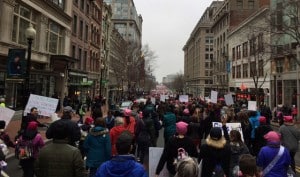
Women’s March 2017: My Personal Experience

march

It is 5:00 a.m. Thursday January 19, 2017. I have no plan except to drive my car 1,193 miles to “show up” in D.C. for the Women’s March. I gas the car; pick up Valerie, and swing by “Southern Maid” for a king cake. Images from “Thelma and Louise” excite and frighten me. We will stay at my stepsister’s near Greenbelt metro station. Louisiana people don’t visit family without a king cake this close to Mardi Gras.

We drive ten hours on Thursday and eight hours on Friday under spacious skies, rainy skies, not so many fruited plains, and gobs of purple mountain majesties. Louisiana, Mississippi, Alabama, Georgia, Tennessee, Virginia. In Tennessee we stop to stretch our legs and buy supplies: whiteboards (dumb), markers, oh-so-nonviolent pink glitter for counter-protestors (prescient), pink heart stickers, pink wrapped chocolates and hot pink bandanas since neither Val nor I knit. We arrive Friday night and my stepsister and her husband make fish tacos for six. Dessert is king cake and Rachel who arrived with Deb from Massachusetts the day before gets the baby. All six of us agree to leave the house at 7:30 a.m. the next morning.

We leave the house at 8:15 a.m. Kind, congenial, and considerate is more important than punctual. The six of us turn into twelve, then twenty four…then too many to count as we migrate to the train station. We smile. We “woo-hoo” at all the great signs. We board the train in numbers that expand exponentially at each train station. We photograph ourselves and each other. I ask my stepsister, “Can I borrow your hat for a selfie?”  Across the aisle I hear, “Do you need a hat?”  I let out a girly squeal, “Seriously?” I may have even fanned my face with my hands.

Three girl scouts and two moms hold open a bag of hand-knitted pink pussy hats. “Pick one.” Val and I chose. Hers is pink knitted plaid (how is that even possible?) Mine is hot pink. Inside are notes: “Dear wearer of this hat…” hand signed by the knitter. Paula from Albany, New York knitted mine. Hugs. Thank yous. We show the notes around then put them in a safe place.  More photos. The doors open. Our numbers expand again. This time the doors can’t close. Despite sitting tight with minimum of personal space we already fill this train beyond capacity. Instinctively we access the secret wisdom normally used for zipping up skinny jeans. We inhale and suck ourselves in so the doors can close. My flesh tingles. I realize I feel physically and psychologically safer now than I’ve felt in months. I “fit in” with this group that is much larger than I realized. Sweet relief. We are not alone. My hope expands in proportion to our numbers.

Police and Metro workers wait in position to hand signal us up from the metro toward the daylight. We flow like mighty rivers surging from twelve different metro stations onto the streets of D.C. until we overflow the banks of our own expectations. As we converge, I see swirls of women, men, children, girl scouts, scientists, federal employees, activists, grandmothers, teachers, cooks, hijabs, signs, geeks, beauties, hippies, a kaleidoscope of humanity moving with one mind and one intention: to show up. We steadfastly ignore our flaws, judgments, egos, agendas, hurts and divisions in order to fully experience what I can only describe as a shared faith that compassion is more important than control. We show up so can look ourselves in the eyes, see who we are, how many we are, and how dedicated we are to wrestling our nation’s arc back toward justice.

It is past one o’clock. Marchers occupy every square foot in every direction as far as I can see. Occasionally a small group passes nearby forging a path in one direction or another. We squeeze elbows in to make way. Discomfort, jostling, and the frustration of immobility escalate but we are steadfastly kind. Kindness is more important than position, proximity, or prominence.

Cell phones don’t work. Instead, we have conversations. Where are you from? How long did it take y’all to get here? Rachel is surrounded by a cluster of young women listening stories about Soujourner Truth. Two Arab women try to help me find a signal. I crave an aerial view to affirm our strength in numbers. Younger marchers climb walls, poles, a stack of pallets from the day before so they can see. I watch a young woman climb a tree to get an elevated view. She loses her footing, regains purchase and finds a stable spot. Her success prompts spontaneous applause and cheers. She didn’t know anyone was watching. I didn’t either. We cheer her beauty, ambition, and perseverance.

My imagination recalls a November trip to see Monarch butterflies hibernating in the mountains of Mexico. I feel like one of those butterflies tightly pressed against millions of others – nature’s safety plan for survival. In the dead of winter it takes togetherness to survive. When it is time for migration, there are individual actions but the lifespan of each butterfly then shortens. The butterflies that return back to Mexico are often seven generations removed from the ones that left in the spring. I see a grandmother with a sign, “Why Am I STILL Marching for Equal Rights?”

A voice shouts, “What. Does. Democracy look like?” “THIS is What. Democracy looks like!” I cannot see the jumbotron. I do not see a stage. I do not hear any speeches (we will watch them later on youtube, Ashley Judd twice) By two p.m. our “battalion” – I don’t know what else to call us – begins to march toward a street that runs parallel to the official parade route. I will return home without ever laying eyes on the official parade route. We are overflow marchers, not extraneous, but evidence of an endless supply. Those who value money and power more than compassion and collaboration should know there are lots more from where we came from.

Police are kind and polite. Two of them snap photos of us from horseback. A man stands in the street playing his violin for us. We walk in the street observed by more marchers now standing on walls and sitting on higher ground taking time to rest and soak it in. Even by 4:00 p.m. signs are still held high by arms that must channel super-duper mother bear strength. I’m tired. I hurt. I beg five minutes rest. Then I keep going.

From outside there will be disdain. Pundits will try to discredit our intent or twist aggressive narratives out of women who merely stand firm against the attack on human rights and human dignity. Selective coverage will misdirect attention. We will be criticized as inarticulate, unfocused, and hypocritical. It will be difficult. We will need more of that super-duper mother bear strength.

The train is an even tighter squeeze on the way back. We are too tired to orchestrate a skinny jeans inhale. Instead we hold on to each other, share seats, sit in laps and accommodate our bulk like Saturday morning sweatpants and a fuzzy blanket. We comfort our mutual exhaustion and look like the Far Side cartoon of a boneless chicken ranch. Dead tired. Until …over the intercom the train conductor asks, “Can I get a woo-o-o?” We give a full-on “woo-o-o” that brings smiles as we listen one last time to our collective voice.

Taking my boots off feels like an orgasm. I am so hungry pizza tastes like nirvana. My exhaustion delivers peaceful delicious sleep.

Sunday we start driving at 11:00 a.m. to a different Tennessee Holiday Inn Express. Monday morning I do an interview with a Shreveport, La. radio station. (paraphrasing). He asks:

“Did you buy any extra ummm, of those, ummm pink hats? I want one!”

“I didn’t see any hats for sale. I got my hat from a Girl Scout on the train. It wasn’t really a merchandizer’s event. All of the hats I saw were handmade, free.”

“So the pink..ummmm, what shall I call it puggy hats…pully hats…p— ”

“You mean pink pussy hats?”

“Wel-l-l-ll, we have to abide by FCC regulations…”

(pause)

“I don’t see a need to rename the hat…but let’s move on. I’ll let you borrow my hat so you can take a selfie if you want.”

“Great! Next question: Do you think Madonna went too far?”

“I think Madonna felt safe enough to vent. I’ve heard schoolteachers say terrible things in a teacher’s lounge that they’d never say in a classroom. I know this event wasn’t private but it felt private to me… It felt like one huge therapy session between a million women collectively on our last nerve. It was an opportunity to speak freely. She did. She was talking to us…not to observers.”

“You don’t sound angry. There were some angry signs out there. Did you see a lot of anger?”

“Umm, not an inappropriate amount. Anger is how we protect ourselves. So it makes sense if signs created by women who feel threatened, who want to protect their rights might look angry. But I think that is what anger is for.”

His questions alerted me that what I experienced is not the story most people will hear. Many layers of meaning will be attributed to the Women’s March on Washington. But deep meaning (any deep meaning) inevitably invokes paradox and is too visceral, emotional, and experiential to share without personal experience or artistic interpretation.

I think you had to have been there, or at least want to imagine what it was like to be there in order to truly understand what it meant to take part in the biggest demonstration in US history.  It meant the world to me.  I hope you find a meaningful point of view that fills your heart with faith that kindness, empathy, and collaboration are more important and more powerful than the disdain, greed, and competitive reasoning currently dividing us.

Filed Under: Annette's Blog, Finding Stories, Stories Help, storytelling ethics Tagged With: Annette Simmons, inspiration, leadership, narrative, storytelling, true stories, Whoever Tells the Best Story Wins

  • « Previous Page
  • 1
  • 2
  • 3
  • 4
  • …
  • 6
  • Next Page »

Storytelling 101

I have a confession to make...

Storyteller’s Confession: My Secret Mission

October 5, 2021 8:59 am

I’ve been trying to infiltrate the halls of power for decades. My secret mission is to increase the diversity of thought by teaching those without a voice how to tell their stories and by teaching leaders how to find and retell stories that broaden everyone’s understanding. Read more →

Posted in: Uncategorized

Stories with a Moral Blueprint – part 8 of 8

May 14, 2020 8:43 am

  We need a Magic School for Storytellers Thirty years before J. K. Rowling created Harry Potter, Ursula Le Guin’s... Read more →

Posted in: Annette's Blog, Big T Truths

Stories with a Moral Blueprint – part 7 of 8

May 13, 2020 7:37 am

  Truth in Storytelling When I wrote the first edition of The Story Factor twenty years ago, I began with the... Read more →

Posted in: Uncategorized

Stories with a Moral Blueprint – part 6 of 8

May 12, 2020 6:48 am

The Moral Dilemmas of a Lion, a Scarecrow, and a Tin Man Frank Baum’s original introduction to The Wizard of... Read more →

Posted in: Annette's Blog, Big T Truths

Stories with a Moral Blueprint – part 5 of 8

May 11, 2020 8:38 am

  Blueprints for Building Trust Learning to drive was fun until I hit the mailbox. I burst into tears, blaming... Read more →

Posted in: Annette's Blog, Big T Truths

Subscribe to Annette's Blog via Email

Enter your email address to subscribe to this blog and receive notifications of new posts by email.

Like us on Facebook:

Like us on Facebook:

Contact Us

Group Process Consulting, LLC
phone: 318.861.9220
email: annette@annettesimmons.com
facebook: www.facebook.com/thestoryfactor

  • Storyteller’s Confession: My Secret Mission

    A Storyteller’s Confession I’ve been trying to infiltrate the halls of power for decades. My … Continue Reading…

    Storyteller’s Confession: My Secret Mission
  • Stories with a Moral Blueprint – part 8 of 8

      We need a Magic School for Storytellers Thirty years before J. K. Rowling created Harry … Continue Reading…

    Stories with a Moral Blueprint – part 8 of 8
  • Stories with a Moral Blueprint – part 7 of 8

      Truth in Storytelling When I wrote the first edition of The Story Factor twenty years … Continue Reading…

    Stories with a Moral Blueprint – part 7 of 8
© Copyright 2021, Group Process Consulting, All Rights Reserved.
Based on the ·Executive Pro Theme/Genesis Framework by StudioPress · Built using WordPress · Log in