Annette Simmons

  • About
    • About Annette
    • Annette in Action
  • Books
    • Territorial Games
    • A Safe Place for Dangerous Truths
    • The Story Factor
    • Whoever Tells the Best Story Wins
  • Services
  • The Six Kinds of Stories
  • Storytelling 101
    • Blog
    • Q & A
    • Metaphor Maps
  • Clients
  • Contact

June 7, 2019 by Annette Simmons 2 Comments

The Story Factor 3rd ed. OCT2019 (new material)

ship
“Ships at a distance have every man’s wish on board.”                          Zora Neale Hurston

From a distance, storytelling also seems to have every man’s wish on board. There is an initial euphoria when you consider that once you learn how to tell stories that alter perceptions, conclusions, and actions you might become captain of all the ships and invent “Get out of jail free” cards for anyone who wants a story of absolution, whether they deserve it or not. Over time, like King Midas, you will discover that getting everything you want inevitably produces unintended consequences. When technology alters moral stories, it changes the meaning and the morals of those stories. King Midas did not anticipate that his golden touch would kill his daughter. In the story, his personal experience of watching the light in her eyes go out carries a sensory impact; we get the message. But when calculated on a spreadsheet, the promise of an infinite return on investment (ROI) after sacrificing just one person can seem like a viable investment strategy. What’s more, people who value utilitarian reasoning now use data distance to create enough emotional distance that they can characterize one person as a “small sacrifice” and therefore a reasonable price to pay. The question is, are we at risk of allowing utilitarian reasoning to guide our storytelling practices? (Excerpt from The Story Factor 3rd ed. Chapter 11 out October 2019 )
Filed Under: Uncategorized Tagged With: Annette Simmons, business storytelling, influence, interview techniques narrative, leadership, true stories, Whoever Tells the Best Story Wins

February 3, 2017 by Annette Simmons 7 Comments

Women’s March 2017: My Personal Experience

march

It is 5:00 a.m. Thursday January 19, 2017. I have no plan except to drive my car 1,193 miles to “show up” in D.C. for the Women’s March. I gas the car; pick up Valerie, and swing by “Southern Maid” for a king cake. Images from “Thelma and Louise” excite and frighten me. We will stay at my stepsister’s near Greenbelt metro station. Louisiana people don’t visit family without a king cake this close to Mardi Gras.

We drive ten hours on Thursday and eight hours on Friday under spacious skies, rainy skies, not so many fruited plains, and gobs of purple mountain majesties. Louisiana, Mississippi, Alabama, Georgia, Tennessee, Virginia. In Tennessee we stop to stretch our legs and buy supplies: whiteboards (dumb), markers, oh-so-nonviolent pink glitter for counter-protestors (prescient), pink heart stickers, pink wrapped chocolates and hot pink bandanas since neither Val nor I knit. We arrive Friday night and my stepsister and her husband make fish tacos for six. Dessert is king cake and Rachel who arrived with Deb from Massachusetts the day before gets the baby. All six of us agree to leave the house at 7:30 a.m. the next morning.

We leave the house at 8:15 a.m. Kind, congenial, and considerate is more important than punctual. The six of us turn into twelve, then twenty four…then too many to count as we migrate to the train station. We smile. We “woo-hoo” at all the great signs. We board the train in numbers that expand exponentially at each train station. We photograph ourselves and each other. I ask my stepsister, “Can I borrow your hat for a selfie?”  Across the aisle I hear, “Do you need a hat?”  I let out a girly squeal, “Seriously?” I may have even fanned my face with my hands.

Three girl scouts and two moms hold open a bag of hand-knitted pink pussy hats. “Pick one.” Val and I chose. Hers is pink knitted plaid (how is that even possible?) Mine is hot pink. Inside are notes: “Dear wearer of this hat…” hand signed by the knitter. Paula from Albany, New York knitted mine. Hugs. Thank yous. We show the notes around then put them in a safe place.  More photos. The doors open. Our numbers expand again. This time the doors can’t close. Despite sitting tight with minimum of personal space we already fill this train beyond capacity. Instinctively we access the secret wisdom normally used for zipping up skinny jeans. We inhale and suck ourselves in so the doors can close. My flesh tingles. I realize I feel physically and psychologically safer now than I’ve felt in months. I “fit in” with this group that is much larger than I realized. Sweet relief. We are not alone. My hope expands in proportion to our numbers.

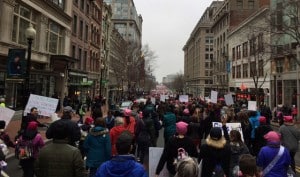
Police and Metro workers wait in position to hand signal us up from the metro toward the daylight. We flow like mighty rivers surging from twelve different metro stations onto the streets of D.C. until we overflow the banks of our own expectations. As we converge, I see swirls of women, men, children, girl scouts, scientists, federal employees, activists, grandmothers, teachers, cooks, hijabs, signs, geeks, beauties, hippies, a kaleidoscope of humanity moving with one mind and one intention: to show up. We steadfastly ignore our flaws, judgments, egos, agendas, hurts and divisions in order to fully experience what I can only describe as a shared faith that compassion is more important than control. We show up so can look ourselves in the eyes, see who we are, how many we are, and how dedicated we are to wrestling our nation’s arc back toward justice.

It is past one o’clock. Marchers occupy every square foot in every direction as far as I can see. Occasionally a small group passes nearby forging a path in one direction or another. We squeeze elbows in to make way. Discomfort, jostling, and the frustration of immobility escalate but we are steadfastly kind. Kindness is more important than position, proximity, or prominence.

Cell phones don’t work. Instead, we have conversations. Where are you from? How long did it take y’all to get here? Rachel is surrounded by a cluster of young women listening stories about Soujourner Truth. Two Arab women try to help me find a signal. I crave an aerial view to affirm our strength in numbers. Younger marchers climb walls, poles, a stack of pallets from the day before so they can see. I watch a young woman climb a tree to get an elevated view. She loses her footing, regains purchase and finds a stable spot. Her success prompts spontaneous applause and cheers. She didn’t know anyone was watching. I didn’t either. We cheer her beauty, ambition, and perseverance.

My imagination recalls a November trip to see Monarch butterflies hibernating in the mountains of Mexico. I feel like one of those butterflies tightly pressed against millions of others – nature’s safety plan for survival. In the dead of winter it takes togetherness to survive. When it is time for migration, there are individual actions but the lifespan of each butterfly then shortens. The butterflies that return back to Mexico are often seven generations removed from the ones that left in the spring. I see a grandmother with a sign, “Why Am I STILL Marching for Equal Rights?”

A voice shouts, “What. Does. Democracy look like?” “THIS is What. Democracy looks like!” I cannot see the jumbotron. I do not see a stage. I do not hear any speeches (we will watch them later on youtube, Ashley Judd twice) By two p.m. our “battalion” – I don’t know what else to call us – begins to march toward a street that runs parallel to the official parade route. I will return home without ever laying eyes on the official parade route. We are overflow marchers, not extraneous, but evidence of an endless supply. Those who value money and power more than compassion and collaboration should know there are lots more from where we came from.

Police are kind and polite. Two of them snap photos of us from horseback. A man stands in the street playing his violin for us. We walk in the street observed by more marchers now standing on walls and sitting on higher ground taking time to rest and soak it in. Even by 4:00 p.m. signs are still held high by arms that must channel super-duper mother bear strength. I’m tired. I hurt. I beg five minutes rest. Then I keep going.

From outside there will be disdain. Pundits will try to discredit our intent or twist aggressive narratives out of women who merely stand firm against the attack on human rights and human dignity. Selective coverage will misdirect attention. We will be criticized as inarticulate, unfocused, and hypocritical. It will be difficult. We will need more of that super-duper mother bear strength.

The train is an even tighter squeeze on the way back. We are too tired to orchestrate a skinny jeans inhale. Instead we hold on to each other, share seats, sit in laps and accommodate our bulk like Saturday morning sweatpants and a fuzzy blanket. We comfort our mutual exhaustion and look like the Far Side cartoon of a boneless chicken ranch. Dead tired. Until …over the intercom the train conductor asks, “Can I get a woo-o-o?” We give a full-on “woo-o-o” that brings smiles as we listen one last time to our collective voice.

Taking my boots off feels like an orgasm. I am so hungry pizza tastes like nirvana. My exhaustion delivers peaceful delicious sleep.

Sunday we start driving at 11:00 a.m. to a different Tennessee Holiday Inn Express. Monday morning I do an interview with a Shreveport, La. radio station. (paraphrasing). He asks:

“Did you buy any extra ummm, of those, ummm pink hats? I want one!”

“I didn’t see any hats for sale. I got my hat from a Girl Scout on the train. It wasn’t really a merchandizer’s event. All of the hats I saw were handmade, free.”

“So the pink..ummmm, what shall I call it puggy hats…pully hats…p— ”

“You mean pink pussy hats?”

“Wel-l-l-ll, we have to abide by FCC regulations…”

(pause)

“I don’t see a need to rename the hat…but let’s move on. I’ll let you borrow my hat so you can take a selfie if you want.”

“Great! Next question: Do you think Madonna went too far?”

“I think Madonna felt safe enough to vent. I’ve heard schoolteachers say terrible things in a teacher’s lounge that they’d never say in a classroom. I know this event wasn’t private but it felt private to me… It felt like one huge therapy session between a million women collectively on our last nerve. It was an opportunity to speak freely. She did. She was talking to us…not to observers.”

“You don’t sound angry. There were some angry signs out there. Did you see a lot of anger?”

“Umm, not an inappropriate amount. Anger is how we protect ourselves. So it makes sense if signs created by women who feel threatened, who want to protect their rights might look angry. But I think that is what anger is for.”

His questions alerted me that what I experienced is not the story most people will hear. Many layers of meaning will be attributed to the Women’s March on Washington. But deep meaning (any deep meaning) inevitably invokes paradox and is too visceral, emotional, and experiential to share without personal experience or artistic interpretation.

I think you had to have been there, or at least want to imagine what it was like to be there in order to truly understand what it meant to take part in the biggest demonstration in US history.  It meant the world to me.  I hope you find a meaningful point of view that fills your heart with faith that kindness, empathy, and collaboration are more important and more powerful than the disdain, greed, and competitive reasoning currently dividing us.

Filed Under: Annette's Blog, Finding Stories, Stories Help, storytelling ethics Tagged With: Annette Simmons, inspiration, leadership, narrative, storytelling, true stories, Whoever Tells the Best Story Wins

September 16, 2016 by Annette Simmons 1 Comment

The Story Factor Audiobook: Connecting the Dots 2001-2016

The Story Factor is now updated and available on audible as an audiobook. Fifteen years of perspective and a genius editor (Stephen Brewer) helped me cut it from 13 hours to 5 hours flat. Producers Jay and Michelle from Beyond Measure Media took me into a real studio and monitored sound quality and my energy levels to meet their high standards. I hope you like it.

In the Steve Jobs tradition, I thought I’d “connect the dots” between the obsessive research (you have no idea), designed interventions, and no charge experiments I’d run on any group of volunteers that would let me and the journey that lead to the original  The Story Factor back in 2001.  I was still in grad school when I attended my first National Storytelling Festival in 1994, but it was a long time I realized how important storytelling is or learned enough to describe storytelling as a type of “intervention.”

In fact, The Story Factor was the third book in a series of three intense periods of research and experimentation, design and testing that began with my search to increase authentic collaboration.  In 1994 my mentor Dr. Jim Farr (founding contributor to Center for Creative Leadership) taught me how to deliver learning experiences using transformational self awareness techniques that improved leadership skills by blending soul-deep examination of intent and beliefs in a way that clarified their definition of success and for some, redirected the traectory of their life.  So… the “team building” tools at that time just seemed terribly superficial in comparison to my experiences running these workshops. I was certain I could find a leverage point for self-awareness that would shift the negative emotions wasting time and resources with phrases like “not my job,” or avoided questions with “who wants to know?” I set out to identify what patterns work against team building:  “When, where, how do we reject collaboration and why?”

For instance, in meetings, subtle messages like a stiff tone of voice, raised eyebrows, or strategically insincere agreements erode trust and decrease our desire to collaborate, share information, support, or even to save the game player from drowning down the line.  So the first book, Territorial Games named ten micro-behaviors or repeated patterns from hundreds of executive’s true stories I had recorded and transcribed.  Most answered first with metaphors like turf war, back stabber, silo or the thank-god-its-a-metaphor “pissing contest.” I’d point out the metaphor was not literally true and then ask “so what actually happened?” These true stories revealed a subterranean language of inclusion and exclusion understood across all cultures. My theory was that evolution designed us with insincts a/k/a emotions  that compel us to acquire and protect territory: no longer hunting grounds and watering holes but the intangible territory that helps us survive and thrive: information, relationships, and status.  Therefore a rational, cognitive desire to collaborate was insufficient without vital emotions like trust and faith.

So AMACOM published Territorial Games and give it away as the 1998 membership gift for joining American Management Association. Clients hired me to help plan mergers, de-escalate infighting, and unlock impasse.  The games worked best with funny stories that neutralized defensiveness and increased self awareness. I provided an alternative story for the “who started it?” question to decrease assumptions of malicious or negligence, which is that these emotional behaviors are hardwired by evolution for survival. “If you play these games, it’s okay, its not your fault…but guess what…those people who you think deserve payback?  It’s not their fault either.” This new story increased self-compassion and a reason to monitor behaviors that sent unconscious signals to back off.  For those who are doing it on purpose – the list of games denied them plausible excuses.

Still, there were long term turf wars that would never go away until all the old stories were exposed to each other in a way that created a bigger story than the us/them causing problems.  Back in grad school (1994) I had written my masters thesis on “dialogue,” drawing from organizational learning, systems theory, social psychology, In 1996 I got ahold of David Bohm’s “On Dialogue” and continued my enduring study of anything from Ed Schein on group process. Armed with this understanding, and the crafty little tricks I learned from my mentor, I wrote A Safe Place for Dangerous Truths: Using Dialogue to Overcome Fear and Distrust.  It was an ambitious design for training a group (60 max, although it worked for 90 at least once) to a.) self-regulate by generating personal and group strategies for pre-empting what I’ve come to call “going to the bad place” and b.) shifting expectations to accomodate the feelings of uncertainty and sheer frustration of stretching your brain wide enough to see that everyone has a piece of the same elephant.  In that book is a shapter on Storytelling as one of the “seven basic facilitator skills.” This is the first time I used simple drawings for common group patterns instead of words.  It was a very successful form of visual storytelling even if I was not yet aware of it.

Everytime I facilitated dialogue I took notes to capture as close to a verbatim transcript as I could.  It turned out the “faulty assumptions” groups decided to abandon were basically stories. And every insight a group dsicovered by examining their bigger story required could not spread from that group to the organization without it’s own stories and metaphors. I realized l was an awkward fish swimming in an ocean of stories.  I wrote the The Story Factor to map the currents.

Fifteen years later, I took time to revisit, update and edit the maps in The Story Factor, producing this audiobook as a result. Let me know what you think!

Filed Under: Annette's Blog, Uncategorized Tagged With: Annette Simmons, business storytelling, group process, leadership, metaphor, narrative, storytelling, The Story Factor, Whoever Tells the Best Story Wins

March 19, 2015 by Annette Simmons Leave a Comment

Arianna Huffington Takes Us on a Tour

The Moth provides storytelling coaching and I imagine that Arianna Huffington has her own team of coaches to help her work on her stories. I think this story is a good example of having a message and then crafting a story to deliver it. [Read more…]

Filed Under: Finding Stories, Stories Help, The Moth - Storytelling HOW TO Tagged With: Annette Simmons, business storytelling, influence, leadership, narrative, storytelling

March 18, 2014 by admin Leave a Comment

The art of seeing the story…

popup1Joe Dager of Business 901 and I begin by talking about the similarities between storytelling and art in this podcast.

I promise to send out a new Story Factor Podcast soon. I’ve been writing and editing the second edition of Whoever Tells the Best Story Wins and there is so much I want to add! [Read more…]

Filed Under: Q & A Tagged With: Annette Simmons, Business 901, business storytelling, influence, inspiration, Joe Dager, leadership, Story Factor podcast, storytelling, true stories

February 4, 2014 by Annette Simmons Leave a Comment

Episode #15 – More Moth Secrets from Lea Thau

Lea Thau

Lea Thau, creative director of TheMoth.org for a decade (2001-2010),

Lea teaches business people not so much how to tell personal stories, but  how to use the principles of storytelling to shape strategy, to roll out new initiatives, or frame business proposals.  However I learned most by asking more about her process at the Moth and with her radio show, Strangers.

Lea Thau is interested in stories with high stakes.   Experienced with the anti-hero stories that dominate the Moth, she looks for stories that contrast the darkest dark with light.  This is kind of extreme sports of storytelling.  It takes, “hours, and hours, and hours” to get it right.

Where she used to spend hours coaching storytellers to tell a story that reduced itself down to a well rehearsed twenty minute performance, she now gathers hours of interviews that must be edited down.  She never has less than 5 and has had up to 20 hours of audio recordings that she edited down to a short twenty minute show.

How in the world does she pick and choose from that much material?

“The first rule is that, what happened ≠ the story of what happened.”

Lea Thau, Former Moth Creative Director

This gives  some perspective on the kind of time it can take to research, develop and tell a powerful story.  When we are lucky, the right story pops into our mind just when we need it. Art can be spontaneous. On the other hand, finding the right story can also take a lot more time than  business people expect. If you love the power of stories, don’t  balk when the process gets complex and finding the core meaning feels like hard work.

 At the end of the day, storytelling is not a checklist, it is a process. 

As a master editor Lea shares one of the primary principles that help her choose – and will help you choose from all the possible detail of an event which details to include.

Editing is about making choices based not only on what actually happened but on which details will demonstrate the meaning of what happened.

Lea’s new show Strangers on KCRW (also a podcast) explores what she sees as a deep cultural shift in how we define “friend” and “stranger.” Is a person you have never met a stranger, even if you’ve been playing video games with them for years? Who is your friend? One episode dives into the world of online dating. One examines the difference between growing up rich and growing up poor. Another explores the happy marriage of two exceedingly normal people who had an arranged marriage along with hundreds of other couples at the 2005 “Moonie” wedding along in Korea.

Lea Thau had a nose for stories and an ear for storytelling perfection.

  • MP3 Download or play this
    episode directly.
  • iTunes Subscribe to The Story Factor Podcast directly in iTunes.
  • RSS Add the podcast to your RSS reader, podcast player or
    manually into iTunes.

Feed link: http://ia601200.us.archive.org/6/items/StoryFactorPodcastEpisode15/StoryFactorPodcastEpisode15.mp3


Filed Under: Podcast Tagged With: Annette Simmons, influence, interview, leadership, narrative, podcast, story, Story Factor podcast, storytelling, true stories

  • « Previous Page
  • 1
  • 2
  • 3
  • 4
  • 5
  • Next Page »

Storytelling 101

I have a confession to make...

Storyteller’s Confession: My Secret Mission

October 5, 2021 8:59 am

I’ve been trying to infiltrate the halls of power for decades. My secret mission is to increase the diversity of thought by teaching those without a voice how to tell their stories and by teaching leaders how to find and retell stories that broaden everyone’s understanding. Read more →

Posted in: Uncategorized

Stories with a Moral Blueprint – part 8 of 8

May 14, 2020 8:43 am

  We need a Magic School for Storytellers Thirty years before J. K. Rowling created Harry Potter, Ursula Le Guin’s... Read more →

Posted in: Annette's Blog, Big T Truths

Stories with a Moral Blueprint – part 7 of 8

May 13, 2020 7:37 am

  Truth in Storytelling When I wrote the first edition of The Story Factor twenty years ago, I began with the... Read more →

Posted in: Uncategorized

Stories with a Moral Blueprint – part 6 of 8

May 12, 2020 6:48 am

The Moral Dilemmas of a Lion, a Scarecrow, and a Tin Man Frank Baum’s original introduction to The Wizard of... Read more →

Posted in: Annette's Blog, Big T Truths

Stories with a Moral Blueprint – part 5 of 8

May 11, 2020 8:38 am

  Blueprints for Building Trust Learning to drive was fun until I hit the mailbox. I burst into tears, blaming... Read more →

Posted in: Annette's Blog, Big T Truths

Subscribe to Annette's Blog via Email

Enter your email address to subscribe to this blog and receive notifications of new posts by email.

Like us on Facebook:

Like us on Facebook:

Contact Us

Group Process Consulting, LLC
phone: 318.861.9220
email: annette@annettesimmons.com
facebook: www.facebook.com/thestoryfactor

  • Storyteller’s Confession: My Secret Mission

    A Storyteller’s Confession I’ve been trying to infiltrate the halls of power for decades. My … Continue Reading…

    Storyteller’s Confession: My Secret Mission
  • Stories with a Moral Blueprint – part 8 of 8

      We need a Magic School for Storytellers Thirty years before J. K. Rowling created Harry … Continue Reading…

    Stories with a Moral Blueprint – part 8 of 8
  • Stories with a Moral Blueprint – part 7 of 8

      Truth in Storytelling When I wrote the first edition of The Story Factor twenty years … Continue Reading…

    Stories with a Moral Blueprint – part 7 of 8
© Copyright 2021, Group Process Consulting, All Rights Reserved.
Based on the ·Executive Pro Theme/Genesis Framework by StudioPress · Built using WordPress · Log in